The “All-or-Nothing” Trap: Why Pragmatic Housing, Not Perfection, Is the Cure for Broome County’s Homelessness Crisis
MyBroome Editorial – By R.D. Milano
Broome County’s homelessness response reached a devastating breaking point with the June 22 fire at the Knights Inn in Endwell, where six people lost their lives and more than fifty vulnerable residents were displaced. In the weeks following the tragedy, encampments on Hawley Street, contentious debates before the County Legislature, and legal claims against the Broome County Department of Social Services have exposed an emergency housing system in collapse.
County spending on temporary motel placements increased from approximately $500,000 in 2019 to $9.5 million in 2025, including more than $700,000 paid to the Knights Inn alone. Millions more have been spent in 2026. Yet people remain precariously housed, encampments continue appearing in public spaces, and Broome County is still searching for somewhere to place residents in crisis.
County Executive Jason Garnar and local lawmakers are now pursuing proposals intended to overhaul the emergency housing system and reduce the county’s dependence on motels. That call creates an opportunity for Broome County to move beyond temporary containment and consider a fundamentally different approach.
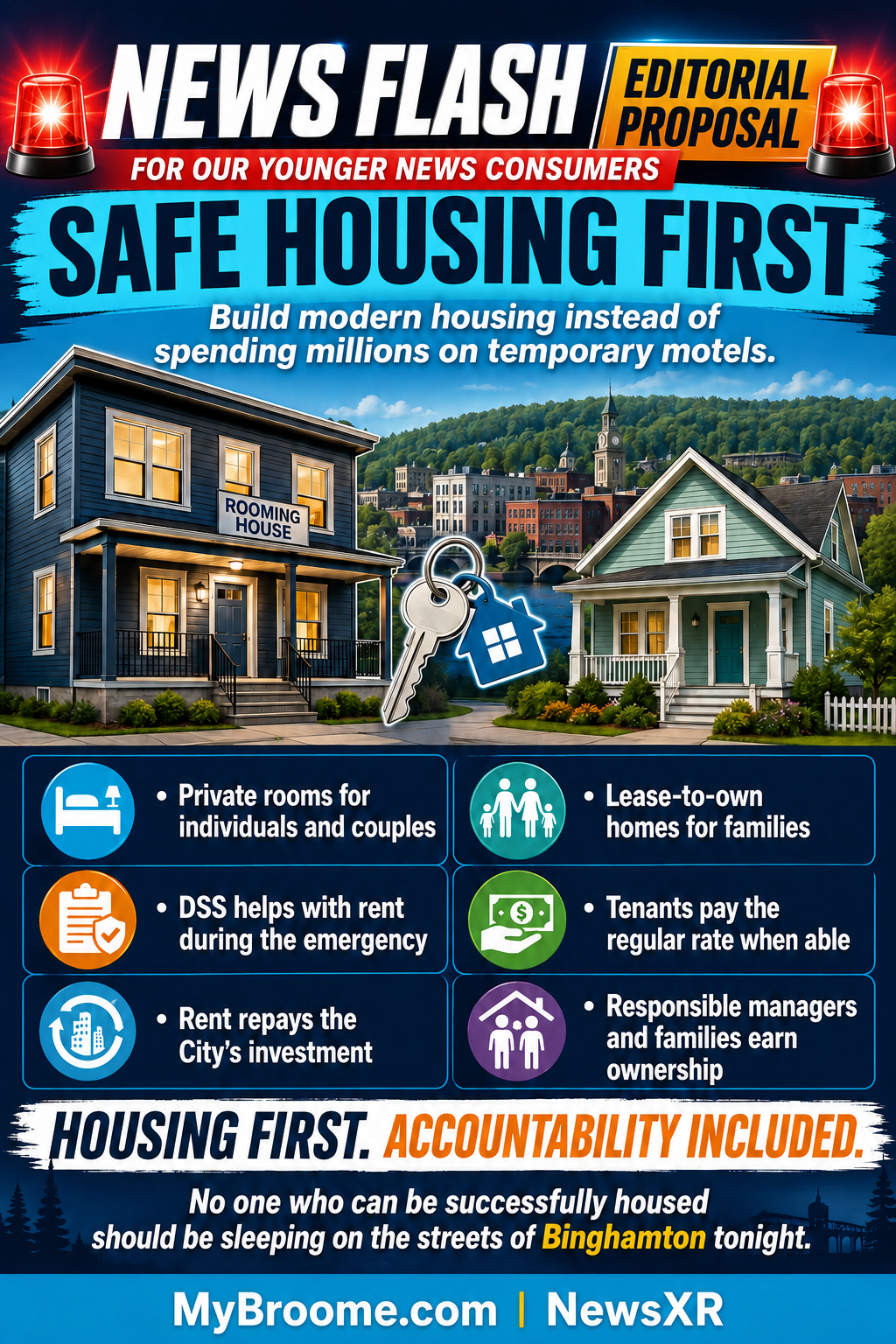
This editorial puts forward one such proposal: a publicly supported Safe Housing First program built around modern private residences, centralized financial controls, mixed-income tenancies, and a pathway to responsible private ownership.
The proposal would not create another government shelter. It would use public investment to create safe, code-compliant private housing, place that housing into responsible hands, recover the taxpayers’ investment through rent, and move people from emergency assistance into ordinary private tenancy.
The Failure of the All-or-Nothing System
The prevailing institutional model expects a displaced person to enter emergency shelter, navigate an exhausting bureaucracy, comply with rigid behavioral requirements, achieve sobriety, stabilize long-standing mental health conditions, and demonstrate personal readiness before being considered worthy of permanent housing.
For people living with chronic alcoholism, addiction, trauma, or serious behavioral health challenges, that sequence is detached from reality.
Homelessness itself compounds trauma. Sleeping outside, moving between unsafe motel rooms, losing possessions, living under constant threat, and never knowing where the next night will be spent intensify the very behaviors the system demands people overcome. Requiring someone to conquer every personal crisis before receiving stable housing does not produce recovery. It ensures that the people with the greatest needs remain trapped outside.
Critics often ask, “If they do not want to get clean, why should we help them?” The answer is visible throughout Binghamton: because the punitive, high-barrier approach has already failed.
Homelessness is increasingly visible. Encampments are appearing in public spaces. Emergency services are being consumed. Neighborhoods are carrying the consequences. Taxpayers are financing an expensive cycle that produces no durable resolution.
This is not merely a compassionate argument. It is a fiscal and public-interest argument.
If Broome County is going to spend $9.5 million on motel vouchers and temporary placements because the emergency cannot legally, practically, or morally be ignored, that money should purchase something more lasting than another night in an unstable room.
Spending millions to preserve homelessness one night at a time is not fiscal responsibility. It is the most expensive form of failure.
Safe Housing Must Come First
Safe Housing First begins with a foundational truth: a safe and predictable place to live is the baseline upon which every other form of stability must be built.
Without that foundation, expecting someone to manage addiction, address mental illness, maintain employment, attend appointments, store medication, care for a pet, or comply with treatment is structurally unrealistic.
Housing first does not mean accountability disappears. It does not mean placing people in unsupervised buildings without rules, safeguards, or intervention. It means that housing becomes the starting point for stabilization instead of the reward issued after stabilization has somehow already been achieved.
The program would regulate harmful conduct rather than attempting to control every private choice made by an adult.
If Joe believes he is a grown adult who has the right to drink a beer, he is correct. Management’s responsibility is to help Joe understand that his right to drink does not include the right to frighten, threaten, disturb, harass, or accost other residents in the hallways.
If drinking makes Joe loud or confrontational, the practical expectation is simple: Joe should remain in his private room until he can safely interact with others. His room gives him somewhere to withdraw without being forced back onto the street.
The rule would not be, “Achieve complete sobriety or lose your home.” The rule would be, “Your conduct cannot violate the safety, security, or peaceful occupancy of anyone else.”
Intoxication would never excuse violence, threatening behavior, property damage, harassment, or persistent disruption. Management would use clear expectations, intervention, individualized planning, treatment referrals when accepted, and additional supervision when necessary. Serious or repeated violations could result in reassignment to a more appropriate placement or removal when required to protect others.
Adults would retain reasonable control over their private lives. Management would retain the authority necessary to protect the shared home.
Inclusive Housing, Not Rigid Housing
Safe Housing First would be inclusive housing tailored to individual needs while preserving the security and integrity of the program.
Inclusivity does not mean abandoning standards. Every resident would still be required to follow rules protecting other residents, staff, visitors, animals, and the property. The difference is that the rules would be designed to make successful housing possible, not to manufacture unnecessary reasons for exclusion.
Couples should be housed together whenever they can safely share a room or unit. The reality is that some unhoused people are established couples. They should not be required to separate as the price of receiving emergency housing.
Residents with disabilities should receive appropriate accommodations. People living with addiction or behavioral health conditions should not be automatically disqualified because they have not achieved complete sobriety or clinical stability. Placements should be based on actual needs, risks, capabilities, and the person’s ability to function within the residence.
The same principle should apply to pets.
Instead of imposing an automatic “no pets” rule that forces someone to choose between housing and an animal that may be that person’s closest companion, the program should invite the pet into the housing plan. In return, the resident must accept assistance in learning how to care for the animal properly and follow established rules governing vaccinations, licensing, veterinary care, waste removal, sanitation, noise, leashes, damage, and the safety of other residents and animals.
The standard would not be unrestricted accommodation. An animal presenting an unmanaged danger could not be admitted until the risk was resolved. Inclusion would operate alongside accountability, not in place of it.
One Program With Two Housing Tracks
The Safe Housing First program would operate through one central administrative office overseeing two housing tracks.
The first would create modern rooming-style residences for individuals and couples. The second would create complete lease-to-own homes for families.
In both tracks, the City of Binghamton would acquire, rehabilitate, or construct the property. Residents would occupy the property through private leases. Rent would recover the city’s verified investment. Once repayment and program requirements were completed, ownership would transfer according to a long-term lease-to-own agreement.
The city would build the housing infrastructure. It would not operate another shelter.
Track One: Modern Managed Rooming Houses
Binghamton badly needs rooming houses, but it does not need a return to neglected buildings, unsafe conversions, overcrowded rooms, absentee landlords, or properties operating outside modern safety standards.
This program would create a new generation of rooming houses designed specifically for safe shared living.
The city would begin by identifying abandoned, tax-foreclosed, or severely deteriorated properties suitable for rehabilitation. Converting those buildings into managed residences would address homelessness and neighborhood blight simultaneously.
When the existing property inventory is insufficient, the city could construct modest, purpose-built two-story residences. The first floor could include a private residence for the live-in manager, an entry area, shared kitchen, dining area, laundry facilities, vending machines, a resident lounge, a modest fitness room, storage, and administrative or meeting space.
The second floor could contain approximately ten to twelve private single-occupancy and couple-occupancy bedrooms, along with properly designed bathrooms, showers, storage, and other necessary residential facilities.
Every property would be professionally rehabilitated or purpose-built, inspected, code-compliant, properly insured, financially supervised, and operated under uniform standards.
Each resident would have a lawful lease, secure access, a private room, access to clean common facilities, and a safe place to store personal belongings. This would be a private residence, not a government dormitory or institutional mega-shelter.
The Primary Lessee and Resident Manager
The first step in opening each residence would be identifying and thoroughly vetting a responsible individual or couple willing to become the primary lessee and resident manager.
For example, the City of Binghamton could lease a completed ten-to-twelve-room residence known as Live Oak House to Russty Milano.
Under the city’s direction, Russty would establish an LLC to serve as the legal operating entity. Program funds could cover the approved formation, filing, licensing, insurance, and initial administrative costs needed to place the LLC into operation.
Russty or a properly vetted management couple would live in the building, establish it as a functioning private residence, maintain the household structure, oversee shared areas, enforce the terms of occupancy, coordinate repairs, address conflicts, and serve as the primary point of accountability.
The remaining rooms would be leased individually to single residents or couples. Every person or couple would receive a written lease establishing the private room, shared facilities, rent, tenancy rights, house rules, and responsibilities.
One resident’s misconduct would not place every other tenancy at risk. Violations would be addressed individually through established intervention and removal procedures.
Mixed-Income Private Tenancies
Live Oak House would accept both emergency-assisted residents and ordinary private tenants.
The regular monthly room rent would be established according to prevailing local rates and adjusted lawfully as market conditions and operating costs change. Using current figures as an example, the normal rate could be approximately $650 per month.
Some residents would begin paying the regular $650 rate immediately. Others would enter through DSS emergency assistance.
During an approved emergency placement, Live Oak House could accept the reduced amount offered by DSS, such as $400 per month, as payment in full. The remaining difference would be treated as a temporary program concession or rent abatement. It would not accumulate as debt or unpaid rent against the resident.
When that resident becomes employed, receives stable income, or otherwise becomes financially capable and DSS ends the assistance, the resident would begin paying the regular established rate prospectively.
If a resident reports, “Now that I am working, DSS is ending my assistance and I will be paying my own rent,” the person keeps the same room, address, lease protections, household relationships, and residential stability. The source and amount of payment change, but the person is not displaced for becoming financially independent.
At twelve occupied rooms, the regular gross rental value at $650 per month would be $7,800 monthly or $93,600 annually.
If six tenants paid the full $650 rate and six DSS-supported tenants paid $400, the property would generate $6,300 per month or $75,600 annually. As assisted residents transitioned to employment or stable income, collected revenue would move toward the property’s full established rental value.
A resident’s source of rent would not determine that person’s status inside the home. Residents would not be identified or separated according to whether they paid privately or received assistance.
Live Oak House would remain a functioning mixed-income private residence, not a building defined exclusively by homelessness.
Centralized Financial Control
The resident manager would not personally collect and spend the house’s rent.
All tenant payments, DSS assistance, emergency housing funds, and approved subsidies would flow automatically into a controlled program trust, escrow, or custodial account established for the operating LLC.
A central program office staffed by one or more employees would handle the books and administrative operations for every participating property.
The office would receive and document rent, pay utilities and approved bills, maintain insurance, create repair and replacement reserves, track vacancies, coordinate inspections, maintain leases, document DSS payments and temporary rent abatements, calculate the city’s repayment, and issue authorized management compensation.
The primary lessee could receive an established management share, such as 6.8 percent of collected rent, or another amount determined by the program. That compensation, any housing benefit, and every authorized operating allowance would be defined in advance.
The resident manager could not independently withdraw program revenue for unrelated personal use. Every dollar would be documented and disbursed according to the established program formula.
The central office would also maintain uniform leases, house rules, safety standards, occupancy records, waiting lists, incident reporting, placement coordination, inspections, and compliance procedures across every residence.
Each home would retain its private identity and resident manager while remaining part of one coordinated housing system.
A Path to Ownership
The primary lessee or management couple would enter a long-term lease-to-own stewardship agreement with the city. Their incentive for accepting responsibility for the residence would be the opportunity to own the property after successfully operating it for an established period, such as fifteen or twenty years.
The city would initially acquire, rehabilitate, or construct the property. Rent collected from private tenants, DSS-supported residents, and other approved housing programs would cover authorized operating expenses and repay the city’s verified investment.
During the agreement, the manager would be responsible for maintaining the household, protecting the building, enforcing lease standards, coordinating repairs, overseeing shared areas, and preserving the program’s security and integrity.
Once the agreed term was completed, the taxpayer’s investment had been fully recouped, and the manager had satisfied every stewardship requirement, ownership would transfer to the manager or the manager’s LLC.
The transfer would be earned through years of responsible operation. Financial misconduct, neglect, abuse of tenants, abandonment, or repeated failure to maintain the property could terminate the ownership pathway.
This creates a powerful incentive to make the house succeed. The manager would not be a temporary employee overseeing somebody else’s building. The manager would be working toward ownership of a safe, well-maintained, modern rooming house while helping residents move from homelessness into stable private tenancies.
Creating Rooms at Scale
The managed-house track would create substantial housing capacity without concentrating hundreds of vulnerable people inside one institution.
Ten residences containing ten to twelve rooms each would create between 100 and 120 private rooms. Twenty-five residences would create between 250 and 300 rooms. Because appropriately sized rooms could accommodate couples, the number of people housed could be higher.
Residents would live in smaller households with private rooms, familiar managers, enforceable rules, and shared responsibility for their homes.
Every rehabilitated or newly constructed property would permanently expand Broome County’s housing inventory. Unlike motel vouchers, those rooms would not disappear when a temporary contract expired. They would remain available as residents stabilized, transitioned to independent housing, or continued successfully living within the managed residence.
Track Two: Lease-to-Own Family Homes
The program’s second track would focus on families who need safe housing but cannot independently acquire a home.
The city could rehabilitate abandoned, tax-foreclosed, or deteriorated houses for family occupancy. When suitable properties were unavailable, it could construct modest and durable two-story homes.
A standard design could include an entryway, living room, kitchen, dining area, bathroom, storage, and attached carport on the first floor, with bedrooms and additional bathroom facilities on the second floor.
The selected family would move into the completed property under a structured lease-to-own agreement and begin paying an affordable rent established by the program. Emergency assistance could initially support the rent when necessary. As the household’s income stabilized, payment responsibility would transition to the family.
All rent would enter the controlled program account. The central office would maintain the property’s books, pay authorized expenses, schedule inspections, document repairs, create reserves, and track repayment of the city’s acquisition, rehabilitation, or construction costs.
Once the city had fully recovered its established investment and the family had successfully completed the agreement, ownership would transfer to that family or its approved family-owned legal entity.
This would not be a traditional public-housing tenancy in which a family pays rent indefinitely without building toward ownership. It would be a controlled pathway from emergency housing to stable tenancy and private homeownership.
The family track would also preserve managed-house rooms for single adults and couples whose needs are better served by shared housing and on-site supervision.
Public Investment That Produces Permanent Results
This proposal would remove the city and county from the business of operating a shelter while preserving public accountability.
The city would provide safe housing infrastructure. A primary lessee would operate each managed residence. Individual tenants would lease the rooms. Families would lease complete homes. DSS could support eligible emergency tenants through its existing payment process. The central office would control the books, bills, reserves, and repayment schedules.
Taxpayers would recover the public investment through rent rather than watching millions disappear into temporary motel placements. Residents would receive lawful private tenancies. Families would receive a path to homeownership. Responsible resident managers would receive a path to ownership of modern rooming houses.
Neighborhoods would receive rehabilitated and supervised properties instead of abandoned buildings. Binghamton would gain hundreds of safe rooms and family homes without constructing one massive institution.
This is more than a homelessness program. It is a housing-development, neighborhood-restoration, employment, and local-ownership program.
The choice is not between curing every unhoused person and doing nothing. The choice is between continuing an expensive system that manages visible human collapse one night at a time, or building a practical system that gets people inside, establishes enforceable boundaries, recovers public investment, and creates the stability from which improvement can begin.
Perfection must no longer be the prerequisite for housing in Broome County. Safe housing should be the beginning of recovery, not the prize awarded at the end of it.
No one who can be successfully housed should be sleeping on the streets of Binghamton tonight.
Leave a Reply