Category: Editorials

  • 𝗦𝗮𝘆 𝗶𝘁 𝗶𝘀𝗻’𝘁 𝘀𝗼 𝗙𝗿𝗲𝗱!

    𝗦𝗮𝘆 𝗶𝘁 𝗶𝘀𝗻’𝘁 𝘀𝗼 𝗙𝗿𝗲𝗱!

    𝗦𝗮𝘆 𝗶𝘁 𝗶𝘀𝗻’𝘁 𝘀𝗼 𝗙𝗿𝗲𝗱!
    ‎
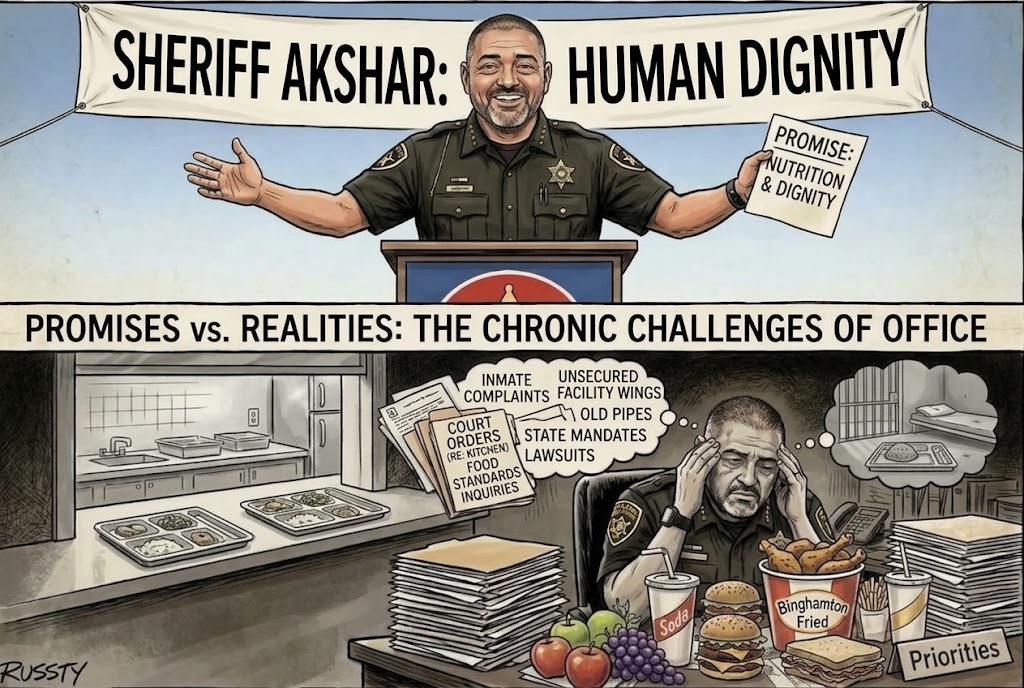
    Greetings Neighbors: As an organization, we do not pick sides in political campaigns or endorse candidates. However, we do support our current Sheriff, Fred Akshar, and we have consistently recognized the great job he has done leading our county’s law enforcement. We like the man and the job he has done, or at least we thought we did.
    ‎
    That is why recent reports regarding the daily food conditions at the Broome County Correctional Facility are so deeply disappointing.
    ‎
    This isn’t about one specific incident or outbreak. This is about a basic, everyday assumption. Sheriff Akshar has explicitly claimed a commitment to improving jail food, and he has frequently cited faith and “God, family, and community” as his guiding principles. We believe in these very same values. Because we believe in them, we are deeply taken aback and disappointed by reports that the reality on the inmate trays hasn’t actually improved.
    ‎
    When Sheriff Akshar took office, he inherited a long, historic legacy of serious allegations regarding inadequate prisoner food quality. Knowing him to be a person who publicly places faith and moral fiber at the center of his leadership, we fully trusted and assumed he would treat those under his charge like human beings. And a human being deserves a decent meal.
    ‎
    Instead, reports from inside show that despite administrative contract changes, real nutritional and quality improvements have not materialized.
    ‎
    Sheriff Akshar, we continue to support your leadership, but we urge you to look closer at what is happening inside the jail kitchen. A person who guides their life by faith and community ensures that even those in our care are treated with basic human decency. Please fulfill the promise you made and make the quality of inmate meals the urgent priority it needs to be. We ask that you keep your word and improve the conditions on the ground (on a plate really). We wanted to remind you of your promise and we’re sure you’ll keep your word, we hope so.
  • The “All-or-Nothing” Trap: Why Pragmatic Housing, Not Perfection, Is the Cure for Broome County’s Homelessness Crisis

    The “All-or-Nothing” Trap: Why Pragmatic Housing, Not Perfection, Is the Cure for Broome County’s Homelessness Crisis

    The “All-or-Nothing” Trap: Why Pragmatic Housing, Not Perfection, Is the Cure for Broome County’s Homelessness Crisis

    MyBroome Editorial – By R.D. Milano

    Broome County’s homelessness response reached a devastating breaking point with the June 22 fire at the Knights Inn in Endwell, where six people lost their lives and more than fifty vulnerable residents were displaced. In the weeks following the tragedy, encampments on Hawley Street, contentious debates before the County Legislature, and legal claims against the Broome County Department of Social Services have exposed an emergency housing system in collapse.

    County spending on temporary motel placements increased from approximately $500,000 in 2019 to $9.5 million in 2025, including more than $700,000 paid to the Knights Inn alone. Millions more have been spent in 2026. Yet people remain precariously housed, encampments continue appearing in public spaces, and Broome County is still searching for somewhere to place residents in crisis.

    County Executive Jason Garnar and local lawmakers are now pursuing proposals intended to overhaul the emergency housing system and reduce the county’s dependence on motels. That call creates an opportunity for Broome County to move beyond temporary containment and consider a fundamentally different approach.

    This editorial puts forward one such proposal: a publicly supported Safe Housing First program built around modern private residences, centralized financial controls, mixed-income tenancies, and a pathway to responsible private ownership.

    The proposal would not create another government shelter. It would use public investment to create safe, code-compliant private housing, place that housing into responsible hands, recover the taxpayers’ investment through rent, and move people from emergency assistance into ordinary private tenancy.

    The Failure of the All-or-Nothing System

    The prevailing institutional model expects a displaced person to enter emergency shelter, navigate an exhausting bureaucracy, comply with rigid behavioral requirements, achieve sobriety, stabilize long-standing mental health conditions, and demonstrate personal readiness before being considered worthy of permanent housing.

    For people living with chronic alcoholism, addiction, trauma, or serious behavioral health challenges, that sequence is detached from reality.

    Homelessness itself compounds trauma. Sleeping outside, moving between unsafe motel rooms, losing possessions, living under constant threat, and never knowing where the next night will be spent intensify the very behaviors the system demands people overcome. Requiring someone to conquer every personal crisis before receiving stable housing does not produce recovery. It ensures that the people with the greatest needs remain trapped outside.

    Critics often ask, “If they do not want to get clean, why should we help them?” The answer is visible throughout Binghamton: because the punitive, high-barrier approach has already failed.

    Homelessness is increasingly visible. Encampments are appearing in public spaces. Emergency services are being consumed. Neighborhoods are carrying the consequences. Taxpayers are financing an expensive cycle that produces no durable resolution.

    This is not merely a compassionate argument. It is a fiscal and public-interest argument.

    If Broome County is going to spend $9.5 million on motel vouchers and temporary placements because the emergency cannot legally, practically, or morally be ignored, that money should purchase something more lasting than another night in an unstable room.

    Spending millions to preserve homelessness one night at a time is not fiscal responsibility. It is the most expensive form of failure.

    Safe Housing Must Come First

    Safe Housing First begins with a foundational truth: a safe and predictable place to live is the baseline upon which every other form of stability must be built.

    Without that foundation, expecting someone to manage addiction, address mental illness, maintain employment, attend appointments, store medication, care for a pet, or comply with treatment is structurally unrealistic.

    Housing first does not mean accountability disappears. It does not mean placing people in unsupervised buildings without rules, safeguards, or intervention. It means that housing becomes the starting point for stabilization instead of the reward issued after stabilization has somehow already been achieved.

    The program would regulate harmful conduct rather than attempting to control every private choice made by an adult.

    If Joe believes he is a grown adult who has the right to drink a beer, he is correct. Management’s responsibility is to help Joe understand that his right to drink does not include the right to frighten, threaten, disturb, harass, or accost other residents in the hallways.

    If drinking makes Joe loud or confrontational, the practical expectation is simple: Joe should remain in his private room until he can safely interact with others. His room gives him somewhere to withdraw without being forced back onto the street.

    The rule would not be, “Achieve complete sobriety or lose your home.” The rule would be, “Your conduct cannot violate the safety, security, or peaceful occupancy of anyone else.”

    Intoxication would never excuse violence, threatening behavior, property damage, harassment, or persistent disruption. Management would use clear expectations, intervention, individualized planning, treatment referrals when accepted, and additional supervision when necessary. Serious or repeated violations could result in reassignment to a more appropriate placement or removal when required to protect others.

    Adults would retain reasonable control over their private lives. Management would retain the authority necessary to protect the shared home.

    Inclusive Housing, Not Rigid Housing

    Safe Housing First would be inclusive housing tailored to individual needs while preserving the security and integrity of the program.

    Inclusivity does not mean abandoning standards. Every resident would still be required to follow rules protecting other residents, staff, visitors, animals, and the property. The difference is that the rules would be designed to make successful housing possible, not to manufacture unnecessary reasons for exclusion.

    Couples should be housed together whenever they can safely share a room or unit. The reality is that some unhoused people are established couples. They should not be required to separate as the price of receiving emergency housing.

    Residents with disabilities should receive appropriate accommodations. People living with addiction or behavioral health conditions should not be automatically disqualified because they have not achieved complete sobriety or clinical stability. Placements should be based on actual needs, risks, capabilities, and the person’s ability to function within the residence.

    The same principle should apply to pets.

    Instead of imposing an automatic “no pets” rule that forces someone to choose between housing and an animal that may be that person’s closest companion, the program should invite the pet into the housing plan. In return, the resident must accept assistance in learning how to care for the animal properly and follow established rules governing vaccinations, licensing, veterinary care, waste removal, sanitation, noise, leashes, damage, and the safety of other residents and animals.

    The standard would not be unrestricted accommodation. An animal presenting an unmanaged danger could not be admitted until the risk was resolved. Inclusion would operate alongside accountability, not in place of it.

    One Program With Two Housing Tracks

    The Safe Housing First program would operate through one central administrative office overseeing two housing tracks.

    The first would create modern rooming-style residences for individuals and couples. The second would create complete lease-to-own homes for families.

    In both tracks, the City of Binghamton would acquire, rehabilitate, or construct the property. Residents would occupy the property through private leases. Rent would recover the city’s verified investment. Once repayment and program requirements were completed, ownership would transfer according to a long-term lease-to-own agreement.

    The city would build the housing infrastructure. It would not operate another shelter.

    Track One: Modern Managed Rooming Houses

    Binghamton badly needs rooming houses, but it does not need a return to neglected buildings, unsafe conversions, overcrowded rooms, absentee landlords, or properties operating outside modern safety standards.

    This program would create a new generation of rooming houses designed specifically for safe shared living.

    The city would begin by identifying abandoned, tax-foreclosed, or severely deteriorated properties suitable for rehabilitation. Converting those buildings into managed residences would address homelessness and neighborhood blight simultaneously.

    When the existing property inventory is insufficient, the city could construct modest, purpose-built two-story residences. The first floor could include a private residence for the live-in manager, an entry area, shared kitchen, dining area, laundry facilities, vending machines, a resident lounge, a modest fitness room, storage, and administrative or meeting space.

    The second floor could contain approximately ten to twelve private single-occupancy and couple-occupancy bedrooms, along with properly designed bathrooms, showers, storage, and other necessary residential facilities.

    Every property would be professionally rehabilitated or purpose-built, inspected, code-compliant, properly insured, financially supervised, and operated under uniform standards.

    Each resident would have a lawful lease, secure access, a private room, access to clean common facilities, and a safe place to store personal belongings. This would be a private residence, not a government dormitory or institutional mega-shelter.

    The Primary Lessee and Resident Manager

    The first step in opening each residence would be identifying and thoroughly vetting a responsible individual or couple willing to become the primary lessee and resident manager.

    For example, the City of Binghamton could lease a completed ten-to-twelve-room residence known as Live Oak House to Russty Milano.

    Under the city’s direction, Russty would establish an LLC to serve as the legal operating entity. Program funds could cover the approved formation, filing, licensing, insurance, and initial administrative costs needed to place the LLC into operation.

    Russty or a properly vetted management couple would live in the building, establish it as a functioning private residence, maintain the household structure, oversee shared areas, enforce the terms of occupancy, coordinate repairs, address conflicts, and serve as the primary point of accountability.

    The remaining rooms would be leased individually to single residents or couples. Every person or couple would receive a written lease establishing the private room, shared facilities, rent, tenancy rights, house rules, and responsibilities.

    One resident’s misconduct would not place every other tenancy at risk. Violations would be addressed individually through established intervention and removal procedures.

    Mixed-Income Private Tenancies

    Live Oak House would accept both emergency-assisted residents and ordinary private tenants.

    The regular monthly room rent would be established according to prevailing local rates and adjusted lawfully as market conditions and operating costs change. Using current figures as an example, the normal rate could be approximately $650 per month.

    Some residents would begin paying the regular $650 rate immediately. Others would enter through DSS emergency assistance.

    During an approved emergency placement, Live Oak House could accept the reduced amount offered by DSS, such as $400 per month, as payment in full. The remaining difference would be treated as a temporary program concession or rent abatement. It would not accumulate as debt or unpaid rent against the resident.

    When that resident becomes employed, receives stable income, or otherwise becomes financially capable and DSS ends the assistance, the resident would begin paying the regular established rate prospectively.

    If a resident reports, “Now that I am working, DSS is ending my assistance and I will be paying my own rent,” the person keeps the same room, address, lease protections, household relationships, and residential stability. The source and amount of payment change, but the person is not displaced for becoming financially independent.

    At twelve occupied rooms, the regular gross rental value at $650 per month would be $7,800 monthly or $93,600 annually.

    If six tenants paid the full $650 rate and six DSS-supported tenants paid $400, the property would generate $6,300 per month or $75,600 annually. As assisted residents transitioned to employment or stable income, collected revenue would move toward the property’s full established rental value.

    A resident’s source of rent would not determine that person’s status inside the home. Residents would not be identified or separated according to whether they paid privately or received assistance.

    Live Oak House would remain a functioning mixed-income private residence, not a building defined exclusively by homelessness.

    Centralized Financial Control

    The resident manager would not personally collect and spend the house’s rent.

    All tenant payments, DSS assistance, emergency housing funds, and approved subsidies would flow automatically into a controlled program trust, escrow, or custodial account established for the operating LLC.

    A central program office staffed by one or more employees would handle the books and administrative operations for every participating property.

    The office would receive and document rent, pay utilities and approved bills, maintain insurance, create repair and replacement reserves, track vacancies, coordinate inspections, maintain leases, document DSS payments and temporary rent abatements, calculate the city’s repayment, and issue authorized management compensation.

    The primary lessee could receive an established management share, such as 6.8 percent of collected rent, or another amount determined by the program. That compensation, any housing benefit, and every authorized operating allowance would be defined in advance.

    The resident manager could not independently withdraw program revenue for unrelated personal use. Every dollar would be documented and disbursed according to the established program formula.

    The central office would also maintain uniform leases, house rules, safety standards, occupancy records, waiting lists, incident reporting, placement coordination, inspections, and compliance procedures across every residence.

    Each home would retain its private identity and resident manager while remaining part of one coordinated housing system.

    A Path to Ownership

    The primary lessee or management couple would enter a long-term lease-to-own stewardship agreement with the city. Their incentive for accepting responsibility for the residence would be the opportunity to own the property after successfully operating it for an established period, such as fifteen or twenty years.

    The city would initially acquire, rehabilitate, or construct the property. Rent collected from private tenants, DSS-supported residents, and other approved housing programs would cover authorized operating expenses and repay the city’s verified investment.

    During the agreement, the manager would be responsible for maintaining the household, protecting the building, enforcing lease standards, coordinating repairs, overseeing shared areas, and preserving the program’s security and integrity.

    Once the agreed term was completed, the taxpayer’s investment had been fully recouped, and the manager had satisfied every stewardship requirement, ownership would transfer to the manager or the manager’s LLC.

    The transfer would be earned through years of responsible operation. Financial misconduct, neglect, abuse of tenants, abandonment, or repeated failure to maintain the property could terminate the ownership pathway.

    This creates a powerful incentive to make the house succeed. The manager would not be a temporary employee overseeing somebody else’s building. The manager would be working toward ownership of a safe, well-maintained, modern rooming house while helping residents move from homelessness into stable private tenancies.

    Creating Rooms at Scale

    The managed-house track would create substantial housing capacity without concentrating hundreds of vulnerable people inside one institution.

    Ten residences containing ten to twelve rooms each would create between 100 and 120 private rooms. Twenty-five residences would create between 250 and 300 rooms. Because appropriately sized rooms could accommodate couples, the number of people housed could be higher.

    Residents would live in smaller households with private rooms, familiar managers, enforceable rules, and shared responsibility for their homes.

    Every rehabilitated or newly constructed property would permanently expand Broome County’s housing inventory. Unlike motel vouchers, those rooms would not disappear when a temporary contract expired. They would remain available as residents stabilized, transitioned to independent housing, or continued successfully living within the managed residence.

    Track Two: Lease-to-Own Family Homes

    The program’s second track would focus on families who need safe housing but cannot independently acquire a home.

    The city could rehabilitate abandoned, tax-foreclosed, or deteriorated houses for family occupancy. When suitable properties were unavailable, it could construct modest and durable two-story homes.

    A standard design could include an entryway, living room, kitchen, dining area, bathroom, storage, and attached carport on the first floor, with bedrooms and additional bathroom facilities on the second floor.

    The selected family would move into the completed property under a structured lease-to-own agreement and begin paying an affordable rent established by the program. Emergency assistance could initially support the rent when necessary. As the household’s income stabilized, payment responsibility would transition to the family.

    All rent would enter the controlled program account. The central office would maintain the property’s books, pay authorized expenses, schedule inspections, document repairs, create reserves, and track repayment of the city’s acquisition, rehabilitation, or construction costs.

    Once the city had fully recovered its established investment and the family had successfully completed the agreement, ownership would transfer to that family or its approved family-owned legal entity.

    This would not be a traditional public-housing tenancy in which a family pays rent indefinitely without building toward ownership. It would be a controlled pathway from emergency housing to stable tenancy and private homeownership.

    The family track would also preserve managed-house rooms for single adults and couples whose needs are better served by shared housing and on-site supervision.

    Public Investment That Produces Permanent Results

    This proposal would remove the city and county from the business of operating a shelter while preserving public accountability.

    The city would provide safe housing infrastructure. A primary lessee would operate each managed residence. Individual tenants would lease the rooms. Families would lease complete homes. DSS could support eligible emergency tenants through its existing payment process. The central office would control the books, bills, reserves, and repayment schedules.

    Taxpayers would recover the public investment through rent rather than watching millions disappear into temporary motel placements. Residents would receive lawful private tenancies. Families would receive a path to homeownership. Responsible resident managers would receive a path to ownership of modern rooming houses.

    Neighborhoods would receive rehabilitated and supervised properties instead of abandoned buildings. Binghamton would gain hundreds of safe rooms and family homes without constructing one massive institution.

    This is more than a homelessness program. It is a housing-development, neighborhood-restoration, employment, and local-ownership program.

    The choice is not between curing every unhoused person and doing nothing. The choice is between continuing an expensive system that manages visible human collapse one night at a time, or building a practical system that gets people inside, establishes enforceable boundaries, recovers public investment, and creates the stability from which improvement can begin.

    Perfection must no longer be the prerequisite for housing in Broome County. Safe housing should be the beginning of recovery, not the prize awarded at the end of it.

    No one who can be successfully housed should be sleeping on the streets of Binghamton tonight.

  • Untitled post 278
    The President’s Spouse is an Employee, Not a Volunteer: It Is Time to Formalize the Role
    A NewsXR Editorial
    The United States government is guilty of a decades-long labor violation hidden in plain sight. For generations, the American public has expected the president’s spouse—historically the First Lady—to serve as a full-time diplomat, policy advocate, and cultural ambassador. Yet, the legal compensation for this grueling, high-pressure job remains exactly zero dollars. [1]
    This outdated arrangement is no longer sustainable. It is a fundamental truth, recognized across human history and codified in the biblical statement, that “the laborer is worthy of his hire” (or a worker is due his wages). It is time for Congress to formalize the position, offering an official federal salary and retirement pension to a spouse who chooses to work, while respecting the right of a spouse who chooses to remain entirely private.

    The Exploitation of Forced Labor
    The current system operates on an antiquated, sexist assumption: that a spouse’s labor belongs to the state by virtue of marriage.
    • The Demands: A modern First Spouse manages a robust staff, anchors national policy initiatives, hosts foreign heads of state, and travels the globe on behalf of American interests.
    • The Cost: They are barred by ethics rules from maintaining an independent career while in office, yet they receive no salary. They are expected to look the part of a global leader, but must buy their own designer wardrobes out of pocket.
    This is not “public service”—it is institutionalized exploitation disguised as tradition. As Ronald Reagan famously noted in 1982: “You know, with the first lady the government gets an employee free; they have her just about as busy as they have me.” Barack Obama echoed this decades later, stating: “Michelle would point out first ladies get paid nothing. So there’s clearly not equal pay in the White House when it comes to her and me.”
    The toxic nature of this unwritten mandate becomes clearest when a spouse attempts to opt out. Look no further than the widespread public and media criticism aimed at Melania Trump during the first half of her husband’s initial term. Because she chose to remain in New York for several months so her son could finish the school year, and initially resisted the relentless pacing of public life, she was routinely vilified by critics. This collective outrage exposed a dark truth about the American electorate: the public feels completely entitled to demand full-time, high-stakes representation from an unelected private citizen, getting angry when that forced volunteerism is not instantly and enthusiastically delivered. [1]

    A Legacy of Legislative and Cultural Impact
    Opponents of a formal salary often dismiss the role as purely social, but history soundly refutes this. First Ladies have repeatedly functioned as the architects of major legislative, cultural, and human rights breakthroughs:
    • Civil and Human Rights: Eleanor Roosevelt fundamentally redefined the position as an activist powerhouse, holding all-female press conferences, inspecting New Deal programs, and later drafting the United Nations’ Universal Declaration of Human Rights.
    • National Policy Initiatives: In 1980, Rosalynn Carter successfully lobbied for the landmark Mental Health System Act while formally establishing the Office of the First Lady. In the 1990s, Hillary Clinton spearheaded the creation of the Children’s Health Insurance Program (CHIP), protecting millions of low-income children.
    • Cultural and Historic Preservation: Dolley Madison strategically united political opponents through diplomacy and saved invaluable national treasures during the War of 1812. 150 years later, Jacqueline Kennedy founded the White House Historical Association, transforming the executive mansion into a legally protected, museum-grade living history institution.
    • Health and Education Reform: Betty Ford bravely broke global taboos by publicly detailing her struggles with addiction and breast cancer, forever changing public health stigmas and launching the world-renowned Betty Ford Center. More recently, Michelle Obama altered federal public school nutrition standards through her Let’s Move! campaign, while Dr. Jill Biden made history by maintaining her career as a full-time college professor while simultaneously launching the $1 billion White House Initiative on Women’s Health Research. [1]
    To suggest that this level of legislative, cultural, and systemic output is merely the “volunteer hobby” of a prominent spouse is an insult to the tangible progress they have delivered to the American people.

    A Two-Tiered, Choose-Your-Own-Adventure Solution
    The solution is to treat the role like any other modern professional position, structured around a clear choice:
                      ┌────────────────────────────────────────┐
                      │       Will the Presidential Spouse     │
                      │         Take on Public Duties?         │
                      └───────────────────┬────────────────────┘
                                          │
                       ┌──────────────────┴──────────────────┐
                       ▼                                     ▼
                    [ YES ]                                [ NO ]
       ┌──────────────────────────────┐       ┌──────────────────────────────┐
       │ • Earns standard fed salary  │       │ • Receives $0 taxpayer funds │
       │ • Vests into a federal pension│       │ • Holds zero public duties   │
       │ • Manages a defined budget   │       │ • Pursues private life/career│
       └──────────────────────────────┘       └──────────────────────────────┘
    

    1. The Active Civil Servant
    If a spouse chooses to lean into the public platform, they should be classified as a federal employee. They should earn a transparent salary—perhaps tied to the wage of a Cabinet secretary—and vest into a standard federal retirement pension upon leaving office. Their duties, travel allowances, and staff should be clearly codified by law, removing the ambiguity that leaves them vulnerable to partisan criticism.
    2. The Private Citizen
    If a spouse refuses public life, they should receive nothing from the taxpayer—and the public must expect nothing from them. They should be free to maintain their own private career, completely out of the spotlight. The social, domestic, and ceremonial hosting duties of the White House would simply be handed over to a professional, hired Chief Social Secretary.

    Overcoming the Political Fear
    Critics will immediately cry “nepotism” and balk at the idea of using taxpayer money to pay a president’s family member. But this is a hollow argument. The American taxpayer is already funding the First Spouse’s staff, office space, and travel. Refusing to pay the person doing the actual work is a failure of basic labor ethics, not a defense of fiscal responsibility.
    The era of the “two-for-one” presidency must end. By formalizing the role, Congress can finally align American governance with modern values—ensuring that if a world leader’s spouse works for the country, they are treated with the professional dignity, pay, and retirement security they have rightfully earned.

    Copyright 2026 – CompanyXR Mediia Group

  • New York’s Broken Prisons: A Reckoning Long Overdue

    New York’s Broken Prisons: A Reckoning Long Overdue

    A NewsXR Editorial

    New York’s Broken Prisons: A Reckoning Long Overdue

    By R.D. Milano

    For generations, Americans have accepted one fundamental truth about incarceration: a prison sentence is the punishment. Abuse, torture, neglect, and death are not. Yet that distinction has become dangerously blurred inside New York’s correctional system.

    The New York Department of Corrections and Community Supervision has recorded 84 deaths in custody between January 1 and July 20, 2026. Independent monitors report that the first half of this year represents the highest number of in-custody deaths in at least six years. Some of those deaths were undoubtedly connected to natural causes within an aging prison population. Others remain under investigation, and some may ultimately prove unavoidable. But that is not the point. The point is that New York’s correctional system has given the public little reason to trust that it can honestly investigate itself.

    That loss of confidence did not begin with the tragic death of Marcos Alcaraz following a cell fire at Eastern Correctional Facility. It did not begin with the horrifying beating death of Robert Brooks at Marcy Correctional Facility, nor did it begin with the killing of Messiah Nantwi at Mid-State. Those cases ripped away the illusion that these were isolated events and exposed a correctional system in deep institutional turmoil.

    The state’s own independent investigation, conducted by the law firm WilmerHale, reached conclusions that should have shaken every elected official in New York. Across its exhaustive review, investigators described a correctional culture consumed by an “us versus them” mentality, one in which excessive force, retaliation, inadequate supervision, ineffective discipline, outdated training, broken complaint systems, and profound leadership failures combined to create conditions where abuse could occur, remain hidden, and too often go unpunished.

    The report did not describe a few bad officers operating outside an otherwise healthy institution. It described an institution that had lost its moral compass and developed systems that repeatedly failed to identify, prevent, expose, and punish serious misconduct.

    Perhaps the most chilling finding was not simply the existence of individual acts of brutality, but evidence suggesting that violence itself had become normalized. Former officers described informal groups known as “goon squads,” “beat down squads,” and “cowboys.” Investigators documented accounts of officers taking force too far, operating within a culture where staff loyalty could become more important than truth, and where those who challenged misconduct or treated incarcerated people with basic humanity risked isolation and retaliation from their own colleagues.

    The report also exposed disturbing failures in the disciplinary process. Officers connected to the deaths of Brooks and Nantwi had histories that included prior misconduct allegations and, in some cases, substantiated complaints. Warning signs existed, yet the system failed to act decisively enough to prevent future violence. Investigations could substantiate abuse only for the disciplinary process to stall or disappear within the machinery of labor relations, arbitration, and institutional resistance.

    The statistics are staggering. Reported uses of force rose from approximately 6,000 in 2016 to roughly 22,000 in 2025, even as New York’s incarcerated population declined. In 2025, the Office of Special Investigations received 1,189 complaints alleging staff assault or excessive or unnecessary force. Only 47 were substantiated, including 40 categorized as excessive or unnecessary force.

    New York’s leaders may point to those low substantiation numbers as evidence that most allegations were unfounded. But when an independent investigation describes fear of retaliation, inadequate investigations, interviews conducted in the presence of accused officers, pressure to withdraw allegations, and widespread distrust of the complaint system, those statistics cannot be treated as proof that the institution is functioning properly. They may instead reveal how rarely the institution is willing or able to validate the accounts of people held entirely under its control.

    The murder of Robert Brooks demonstrated what happens when this culture collides with undeniable evidence. Unlike countless previous incidents that occurred without clear video documentation, the attack on Brooks was captured by body-worn cameras. The footage showed a restrained and handcuffed man subjected to brutal violence while other employees participated, watched, failed to intervene, or became entangled in the institutional response that followed.

    For once, New York could not explain away what the public had already seen. Prosecutors pursued criminal charges, convictions followed, plea agreements were reached, and employees faced termination or suspension. Those actions were necessary, but prosecuting the individuals whose conduct became impossible to deny cannot be mistaken for accountability across the entire institution.

    Prosecutors and investigators examining these killings alluded to something much larger than misconduct confined to one shift, one group of officers, or one prison. Their work exposed evidence of a broader culture of abuse, concealment, silence, and institutional protection reaching beyond the walls of Marcy or Mid-State.

    In virtually every other institution, evidence suggesting a systemic pattern of abuse would trigger something massive. Investigators would begin combing through prior deaths, serious injuries, use-of-force incidents, medical reports, grievance records, disciplinary histories, and allegations involving similar personnel, practices, or facilities. They would search for common methods, repeated explanations, overlooked victims, concealed injuries, falsified reports, and opportunities to stop the abuse before another person was harmed or killed.

    That is what accountability demands when prosecutors discover evidence suggesting that known victims may not have been the first. Investigators do not simply prosecute the case in front of them and close the door. They look backward for other victims, outward for similar conduct, and forward for every possible way to stop it from happening again.

    New York has not demonstrated that same urgency across its prison system. Despite documented cover-ups, unreliable reporting, ignored warning signs, retaliation concerns, and evidence that brutality was not always isolated, the state has not subjected every questionable DOCCS death or serious injury to the level of independent scrutiny such findings demand.

    Instead, New York appears determined to contain each scandal, prosecute those whose actions can no longer be hidden, announce another reform, and move on. The state wants to close the door and hope the public eventually allows the noise behind it to fade.

    If the prosecutors were right, if the advocacy organizations that have documented abuse for decades were right, and if the independent investigation commissioned by the State of New York was right, then we are no longer talking about poor management, inadequate training, or the misconduct of a handful of correction officers. We are talking about the systemic abuse, degradation, intimidation, and dehumanization of incarcerated individuals by employees acting under the authority of the State of New York.

    What we are really talking about is crimes against humanity happening right here in New York.

    This is one of the most progressive and liberal states in the union. New York’s leaders speak constantly about justice, equality, civil rights, and human dignity. How, then, can this be happening within institutions operating under their authority? How can our leaders be so incompetent that they are unable to control the correctional system they oversee? How can they be so uncaring that they know the depth of the abuse and still refuse to take the drastic steps necessary to expose it, dismantle it, and stop it?

    Either New York’s leaders do not understand the scale of the institutional crisis unfolding inside their prisons, or they understand it and have chosen not to confront the full truth. Neither explanation is acceptable.

    We will not allow that door to close.

    The people of New York cannot permit the state to move forward without a complete accounting of what happened, how long it was allowed to happen, how many people may have been victimized, and which leaders knew enough to act but failed to take the drastic steps necessary to stop it.

    Institutions do not heal by turning the page. They heal by reading every page that came before it, including the pages stained by violence, negligence, indifference, concealment, and the unanswered grief of families who still do not know the full truth about how their loved ones died.

    Every questionable death deserves renewed scrutiny. Every serious injury that may have been dismissed under the old culture deserves another look. Every credible allegation of excessive force, medical neglect, retaliation, evidence tampering, or falsified reporting deserves independent review. Every family that was handed a limited explanation by an institution now shown to have serious credibility problems deserves the opportunity to have that explanation examined again.

    This does not mean every person who died in custody was murdered or that every unexplained injury resulted from criminal conduct. It means the institution has forfeited the right to demand blind trust in its own conclusions. The documented culture of abuse, silence, retaliation, failed oversight, and weak accountability makes a broader review not only reasonable, but necessary.

    The purpose of that reckoning is not merely to uncover yesterday’s victims. It is to protect tomorrow’s. Every day this broken culture remains intact is another day an incarcerated person may be abused, another correction officer may be pressured into silence, another medical employee may be forced to choose between truth and institutional loyalty, and another family may receive a phone call that changes their lives forever.

    New York cannot simply prosecute yesterday’s crimes while allowing the conditions that produced them to survive into tomorrow. A democratic society has an obligation not only to investigate systemic abuse after it is exposed, but to dismantle the system that allowed it to flourish and to stop the next death before it happens.

    This crisis is not only about incarcerated people. It is also about correction officers who perform their duties honorably while working within an institution where the misconduct of others destroys public confidence in the entire profession. It is about nurses, counselors, civilian employees, and supervisors placed inside a culture where honesty can carry consequences and silence can become a form of protection.

    It is about grieving families who deserve answers instead of evasions. It is about taxpayers who fund a correctional system with the expectation that constitutional standards will be upheld. Most importantly, it is about the character of New York itself.

    A great democratic state cannot claim moral leadership while operating a prison system defined by an alarming death rate, documented brutality, repeated allegations of concealment, broken oversight, and a persistent disregard for the humanity of those in its custody.

    Leadership bears responsibility for more than issuing statements of concern, commissioning reports, or implementing another limited round of policy revisions. Leaders who know the depth of these failures and refuse to fully expose them become part of the failure. They own the system they continue to operate, the culture they decline to dismantle, and the consequences of every warning they ignore.

    Real leadership must begin by acknowledging the whole truth, not a sanitized version designed for a press conference and not a politically convenient version that isolates each death from the institutional culture surrounding it. New York must admit that its correctional system has become deeply corrupt, dangerously incompetent, heavily shielded from accountability, and unworthy of the democratic values the state claims to represent.

    That reckoning requires an independent, system-wide review of questionable deaths, serious injuries, use-of-force incidents, medical failures, suppressed grievances, retaliation allegations, falsified records, and leadership decisions reaching back years. It requires investigators who do not answer to DOCCS, prison administrators, correctional unions, or the political officials whose reputations may depend upon limiting what becomes public.

    It also requires consequences. No more reports that document systemic failure without identifying who allowed it to continue. No more commissions whose recommendations can be quietly delayed, weakened, or absorbed into the same bureaucracy they were created to reform. No more leaders celebrating minor statistical improvements while people continue dying within a system already shown to conceal abuse and resist accountability.

    We said it when we first began reporting on New York’s prison crisis, and the evidence assembled since has only strengthened our conviction: the monsters behind New York’s prison walls wear blue, not green.

    That statement is not an accusation against every correction officer. It is an indictment of a culture in which state authority, a uniform, institutional silence, and unchecked power have too often been used to abuse, neglect, dehumanize, and sometimes kill the people New York is legally and morally obligated to protect.

    The greatest danger to justice inside New York’s prisons is not the color of an incarcerated person’s uniform. It is a culture that has tolerated brutality, concealed misconduct, ignored warning signs, protected abusive employees, and repeatedly failed to value the humanity of those in its custody.

    Until New York fully exposes that culture, reexamines every credible case it may have touched, holds leadership accountable, and takes the drastic steps required to stop the abuse, reform will remain little more than a promise issued after another death.

    No more commissions without consequences. No more reforms that leave the underlying culture intact. No more treating each death as an isolated tragedy when the evidence reveals a systemic crisis. No more closing the book before every page has been read and every possible victim has been heard.

    The people of New York deserve the truth. The families deserve the truth. The honorable correction officers who have served with integrity deserve the truth. Every person still living behind those walls deserves a correctional system governed not by fear, indifference, retaliation, or institutional self-protection, but by the rule of law and the dignity that belongs to every human being.

    Only then can New York begin rebuilding a correctional system worthy of a great democratic state.

  • Sunday Dinner & That’s What’s Up Broome County: The Quiet Heroes Keeping Our Seniors Connected

    Sunday Dinner & That’s What’s Up Broome County: The Quiet Heroes Keeping Our Seniors Connected

    Sunday Dinner & That’s What’s Up Broome County: The Quiet Heroes Keeping Our Seniors Connected
    BINGHAMTON, NY — When you think of a traditional Sunday dinner, you think of more than just a hot meal. You think of safety, family, and the comforting reassurance that someone is looking out for you. Across Broome County, a dedicated group of local residents is actively expanding that exact familial spirit past their own dining tables and directly into the homes of our most vulnerable neighbors.
    They are the driving force behind Faith in Action Volunteers (FIAV), a homegrown care network managed by the Broome County Council of Churches. Operating entirely on neighborly kindness, this initiative pairs local volunteers with homebound frail elderly, chronically ill, and disabled residents. Their shared mission is simple yet vital: helping our seniors maintain their absolute independence, health, and dignity right at home. [1, 2]
    That’s What’s Up: Breaking Isolation One Grocery Run at a Time
    While regional headlines frequently focus on sweeping political or economic changes, the real backbone of the Southern Tier is reinforced through much quieter acts of service. Every single week, local volunteers step up to provide critical, non-medical home services.
    The day-to-day impact of these efforts acts as a literal lifeline across our towns:
    • The Shopper Program: Volunteers receive grocery lists and payment, head out to local markets, and drop fresh, nutritious food directly to seniors who cannot leave their homes.
    • Ramp It Up: Teams regularly volunteer to construct sturdy wheelchair ramps, transforming previously inaccessible houses into open homes. [1]
    • Chop and Chat: Local senior centers host these group sessions, bringing older adults together to prep healthy ingredients, share recipes, and combat social isolation. [1, 2]
    • Essential Transit: Beyond food, volunteers donate their time and vehicles to drive neighbors to critical medical appointments, provide light housekeeping, and make weekly companionship phone calls.
    Why This is the Ultimate “Sunday Dinner” Story
    This isn’t corporate charity—it is pure community fiber. It is an Endicott neighbor giving up a Tuesday morning to drive a stranger to dialysis. It is a Binghamton resident picking up an extra gallon of milk for someone three blocks away.
    These volunteers provide the ultimate gift: peace of mind. They prove that in Broome County, we do not let our elders slide into invisibility. We pull up an extra chair, we check in, and we look out for one another.
    How to Get Involved or Request Help
    The need for local helping hands remains exceptionally high, particularly for the expanding Shopper Program. If you have a valid driver’s license and a few spare hours a month, you can directly change a senior’s life.
    • To Volunteer: Reach out directly to the organizers listed on the official Broome County Council of Churches Volunteer Portal. You can also coordinate with the coordinators by calling the FIA office at (607) 724-9130 ext. 318.
    • To Refer a Senior: If you know an older adult resident in Binghamton, Johnson City, Endicott, or the surrounding towns who needs assistance with groceries or medical transit, use the same contact line to request a volunteer pairing.
    And that’s what’s up Broome County!

  • Sunday Special Editorial: State Obstruction Is Still Obstruction

    Sunday Special Editorial: State Obstruction Is Still Obstruction

    Sunday Special Editorial

    When States Weaponize Government to Circumvent Federal Authority: It’s Obstruction of Justice

    Most Americans have never heard of a program called 287(g), yet it has become the center of one of the most important constitutional battles unfolding in America today.

    Section 287(g) of the Immigration and Nationality Act allows the federal government to enter into voluntary agreements with state and local law enforcement agencies. Under those agreements, specially trained deputies may perform limited federal immigration enforcement functions while operating under federal supervision. Counties are not required to participate. Those that do make that decision voluntarily, entering into agreements with the United States government.

    That is exactly what Broome County Sheriff Fred Akshar and a number of other New York sheriffs have done.

    Governor Kathy Hochul has ordered those agreements terminated by August 25, arguing they conflict with New York law and public policy. Attorney General Letitia James has taken legal action to enforce that position. The federal government has responded by challenging New York’s actions in court, arguing the state cannot interfere with voluntary cooperation between local law enforcement and federal immigration authorities. The constitutional questions are significant enough that this dispute could eventually find its way before the United States Supreme Court.

    On its surface, this appears to be another political fight over immigration.

    It is not.

    It is a fight over whether government itself may become an obstacle to the lawful execution of another government’s constitutional authority.

    It is also important to acknowledge the political reality. The overwhelming majority of New York sheriffs participating in 287(g) agreements are Republicans or generally aligned with conservative immigration policies. Governor Kathy Hochul and Attorney General Letitia James are Democrats who have consistently opposed those policies. No one should pretend politics is absent from this dispute.

    But politics is not the issue. The issue is whether political disagreement justifies the weaponization of government power.

    Many Americans will immediately ask whether they support President Trump’s immigration policies. That is the wrong question.

    Whether you support the Republican administration’s immigration agenda, oppose it entirely, or fall somewhere in the middle is almost irrelevant to the constitutional issue before us.

    The American people elected a Republican President. They elected a Republican-controlled Congress. Under our Constitution, immigration policy has long been recognized as primarily the responsibility of the federal government because it directly affects national sovereignty, border security, foreign affairs, and our relationship with the rest of the world. States have important responsibilities, but they were never intended to become competing immigration authorities capable of nullifying federal policy simply because they disagree with the outcome of a national election.

    That is precisely what New York is attempting to do.

    Governor Hochul and Attorney General James are not merely criticizing federal immigration policy. They are using the authority of state government to prevent that policy from being carried out by independently elected sheriffs who have voluntarily entered lawful agreements with the federal government. The objective is no longer simply to express disagreement. The objective is to stop the federal government from carrying out the immigration policies chosen by the American people through their national elections.

    That is obstruction.

    It is also a dangerous precedent.

    Today, a Democratic governor and Democratic attorney general are attempting to frustrate the policies of a Republican federal government. Tomorrow, political power will inevitably change. Republican governors and Republican legislatures could employ the very same tactics to obstruct the policies of a future Democratic administration. Environmental regulations. Firearms enforcement. Civil rights initiatives. Education. Health care. The subject does not matter. The precedent does.

    Once states embrace the idea that they may weaponize governmental authority to circumvent federal law whenever they dislike the party controlling Washington, the Constitution ceases to function as the nation’s governing framework. It becomes little more than a political suggestion.

    America cannot survive if every election is followed by a campaign to sabotage the lawful authority of the government the voters just elected. We are a constitutional republic, not fifty competing governments engaged in perpetual political warfare.

    Government exists to faithfully execute the law, not to manipulate public institutions into serving political ideology. Executive authority is meant to govern, not punish political disagreement. Attorneys general are expected to uphold the law, not become political enforcers against independently elected constitutional officers. Sheriffs answer first to the citizens who elected them and to the Constitution they swore to uphold – not to the ideological priorities of Albany.

    This editorial is not about whether one favors stronger immigration enforcement or more permissive immigration policies. Elections have consequences, and in our constitutional system the authority to establish and enforce national immigration policy belongs primarily to the federal government. Americans remain free to debate those policies, to vote against them, and ultimately to replace those who enacted them. What they should not do is encourage one level of government to obstruct another simply because they dislike the result of an election.

    If New York prevails here, every future state government will have a roadmap for resisting federal authority whenever political control is divided. That is not federalism. That is institutionalized political obstructionism.

    Just as we condemn the recklessness of some of Donald Trump’s statements leading up to the January 6 attack on the United States Capitol, we also condemn reckless statements by state and local officials across the country encouraging citizens to resist, interfere with, confront, or harass ICE officers while they are carrying out lawful operations. Political leaders have a responsibility to challenge government policy through the courts, legislation, elections, and peaceful public advocacy. They do not have the right to inflame the public, encourage direct interference with law enforcement, or create conditions in which officers, protesters, bystanders, and entire communities are placed in danger. That standard must apply equally regardless of the party, the administration, or the cause.

    The Constitution established separate sovereigns, not rival governments empowered to sabotage one another whenever elections produce different winners. That principle cannot depend on which party controls Washington or which party controls Albany.

    If Democrats controlled the White House and Congress, and a Republican governor and legislature were using state power to obstruct lawful federal authority in precisely the same manner, we would oppose it just as strongly. Political obstructionism does not become constitutional simply because we agree with the people doing it.

    The proper place to challenge federal authority is in the courtroom or at the ballot box. It is not through a state legislative session designed to circumvent federal law, frustrate federal enforcement, or punish locally elected officials for cooperating with the national government.

    The rule of law must remain the rule of law regardless of party. Government exists to execute the law faithfully, not to weaponize its institutions to frustrate the lawful authority of another sovereign government.

    When states deliberately weaponize government to circumvent federal authority, there is a name for it.

    It is obstruction of justice, and it is wrong.


    👉 What do you think? Should states be permitted to interfere with voluntary cooperation between local law enforcement and the federal government, or does that cross a constitutional line? Join the conversation in the comments below.

    © 2026 CompanyXR Media Group – NewsXR. All Rights Reserved.

  • A NewsXR Editorial: Starbucks Is Wrong.

    A NewsXR Editorial: Starbucks Is Wrong.

    A NewsXR Editorial

    Starbucks Fired Two Employees for Defending Themselves. We Believe the Company Is Wrong.

    When two masked men entered a Starbucks on South Grand Boulevard in St. Louis in December 2023, employees Michael Harris and Devin Jones-Ransom were forced into a situation no worker should ever have to face. The suspects demanded cash and displayed what appeared to be a handgun. Harris attempted to comply, but because he lacked the manager authorization needed to immediately open the register, one of the robbers pistol-whipped him in the head.

    Believing their lives were in immediate danger, Harris and Jones-Ransom fought back. They subdued one suspect and held him until police arrived, while the second suspect fled and was later apprehended. During the struggle, part of the weapon broke away, revealing it to be a replica firearm. Both suspects were eventually convicted and sentenced to prison.

    A few weeks later, Starbucks fired both employees for violating the company’s workplace safety policy, which directs workers to comply with robbery demands and avoid physical intervention. Harris and Jones-Ransom later filed a wrongful termination and negligence lawsuit against Starbucks. In March 2026, the Missouri Court of Appeals rejected the company’s attempt to force the case into private arbitration, allowing the lawsuit to proceed in St. Louis Circuit Court.

    The courts will decide whether Starbucks acted within the law, but the question of whether the company acted fairly is much easier to answer.

    We understand why Starbucks maintains a policy of inaction, submission, and de-escalation during a robbery. In many situations, compliance is the safest response, and employers have every right to train workers not to resist, pursue suspects, or place themselves and others at greater risk over company property. Those policies exist for a legitimate reason, and we do not dispute the value of having them.

    What we dispute is the rigid and deeply unfair application of that policy after an employee has already been violently attacked and reasonably believes his life is in danger. Harris reportedly tried to comply. He did not rush the suspects, chase them from the store, or decide that protecting a cash register was worth risking his life. He was unable to open the register quickly enough, and he was struck in the head with what appeared to be a firearm.

    At that point, this was no longer a simple robbery in which an employee was being asked to hand over money. It had become a violent assault, and the people inside that store had no way of knowing that the weapon was fake or what the suspects intended to do next. Too many people have heard stories of robberies where the money was surrendered and the victims were still beaten, shot, or killed. Compliance does not come with a guarantee of survival.

    No one sitting in a corporate office can fairly recreate the fear, confusion, pain, and adrenaline of that moment. Starbucks executives were not inside the store, they were not staring at what appeared to be a gun, and they were not the ones forced to decide within seconds whether fighting back was the only way to stay alive. The employees were the people facing that danger, and their actions must be judged with a real understanding of the circumstances they were placed in.

    Starbucks still had the right to address the policy violation, but termination was not the only option available. The company could have issued a formal reprimand, required additional training, imposed a suspension, or taken another corrective action that reinforced its safety rules while acknowledging the extraordinary danger these employees faced. Discipline could have been measured, humane, and grounded in the reality of the event.

    Instead, Starbucks chose to fire them, and that decision appears arbitrary, capricious, and fundamentally wrong. It sends the message that corporate policy must be followed without exception, even when an employee has already been assaulted and reasonably believes he may be seriously injured or killed. Policies are supposed to protect people, not become weapons used against them after they survive a violent encounter.

    People should not lose their jobs for protecting themselves when they reasonably believe their lives are in immediate danger. It is easy to second-guess a survival decision after the fact, but it is entirely different to make that decision while injured, terrified, and unsure whether the next moment may be your last.

    Because of the blatant unfairness of Starbucks punishing these employees for defending themselves, I will never spend another penny with the brand, and that’s a fact.

    👉 What do you think? Was Starbucks right to enforce its policy, or should the company have recognized the extraordinary circumstances these employees faced? Drop your comments below.

    The civil allegations remain pending. Starbucks denies liability, and no final ruling has been issued on the underlying claims.

    © 2026 CompanyXR Media Group – NewsXR. All Rights Reserved.

  • The Factionization of America: How the Modern Two-Party System Validated the Founders’ Worst Nightmare

    The Factionization of America: How the Modern Two-Party System Validated the Founders’ Worst Nightmare

    The Factionization of America: How the Modern Two-Party System Validated the Founders’ Worst Nightmare

    By the NewsXR Editorial Board

    When the New York State Supreme Court sentenced Donald J. Trump to an unconditional discharge, the legal system attempted to navigate one of the most unprecedented moments in American history. Legally, the 34 felony convictions remained part of the permanent judicial record. Politically, however, the American people rendered a separate judgment at the ballot box, returning him to the nation’s highest office despite those convictions. Whether one believes that outcome represented justice, injustice, accountability, or political persecution depends largely upon where they stand politically. What cannot reasonably be disputed is that the moment exposed a much larger constitutional reality – one that reaches far beyond Donald Trump himself.

    The significance of that moment was never about a single politician. It was about the growing divide between America’s institutions and the public’s confidence in those institutions. Increasingly, Americans no longer begin with the facts of an investigation, a court ruling, or an agency decision. They begin by asking who controlled the institution that made it. Millions of Republicans question whether Democratic administrations have used prosecutors, intelligence agencies, regulatory bodies, and congressional investigations to pursue political opponents. Millions of Democrats question whether Republican leaders have attempted to undermine elections, expand executive power beyond constitutional limits, politicize oversight, and weaken institutional safeguards for political gain. Each side believes the other has crossed constitutional lines. Each side believes the stakes are existential. Each side increasingly views victory not as an opportunity to govern, but as protection against what it believes the opposing faction will do if it regains power.

    That mutual distrust has fundamentally altered the way Americans view government itself. Court decisions are no longer simply legal rulings. Congressional hearings are no longer viewed merely as oversight. Executive orders are no longer temporary policy tools. Federal agencies are no longer broadly assumed to be politically neutral. Nearly every institution has become viewed through a partisan lens, leaving millions of Americans convinced that the machinery of government is being used not only to govern the nation but to defeat political opponents. Whether those perceptions are fully justified in every instance is almost beside the point. Confidence in institutions depends as much upon public trust as legal authority, and that trust has steadily eroded.

    The consequences are now visible throughout every level of government. Rather than building upon the work of previous administrations, each change in political power increasingly brings systematic dismantling. Republicans reverse Democratic executive orders. Democrats reverse Republican executive orders. Environmental regulations are written and rewritten. Energy policies expand and contract. Immigration priorities shift dramatically. Major infrastructure initiatives are redesigned or abandoned. International agreements are entered into, withdrawn from, and renegotiated. Billions of taxpayer dollars are spent building policies that survive only until the next election, when billions more are spent undoing them. The result is not steady governance but an expensive political pendulum that repeatedly tears down yesterday’s priorities to build tomorrow’s, only to begin the cycle again four years later.

    The offices of President, Governor, Attorney General, District Attorney, and even Congress itself have increasingly become viewed as strategic positions in an ongoing struggle for institutional control. Every election now carries the expectation that investigations will begin, executive powers will expand, appointments will shift ideological balance, regulations will be rewritten, and political opponents will spend the next four years attempting to reverse nearly every major action taken by their predecessors. The Constitution envisioned separated powers acting as checks upon one another. Increasingly, however, Americans witness competing factions attempting to use those same constitutional powers as political weapons against one another. Every new precedent established by one administration becomes justification for the next to answer in kind, creating an escalating cycle of political retaliation that neither side appears willing to end.

    That cycle has become self-perpetuating. Each party argues its actions are justified because the other side acted first. Republicans point to Democratic investigations, prosecutions, regulatory actions, and executive authority as evidence of institutional weaponization. Democrats point to Republican challenges to elections, executive actions, congressional investigations, and efforts to reshape federal institutions as proof that extraordinary measures are necessary. The accusations flow in both directions, the responses become increasingly aggressive, and each election simply resets the battlefield for another round. Regardless of which side one supports, the pattern itself has become unmistakable. Political victories are increasingly measured not only by the ability to govern, but by the ability to undo, investigate, prosecute, regulate, subpoena, or otherwise neutralize political opponents. The result is an endless cycle of political retribution that steadily weakens public confidence in every institution caught in the middle.

    Taken together, these developments resemble something the United States has rarely acknowledged openly. America is not experiencing a conventional civil war fought with armies across battlefields. It is experiencing what increasingly resembles a political cold civil war – a nation divided into rival factions that occupy the same territory, operate under the same Constitution, and participate in the same elections while steadily losing confidence in one another and in the institutions meant to serve them all. The weapons are no longer muskets and artillery. They are lawsuits, criminal prosecutions, congressional investigations, executive orders, regulatory actions, confirmation battles, media campaigns, and elections increasingly framed as battles for the survival of the Republic itself. Instead of seeking lasting solutions to national problems, each side increasingly prepares for the next opportunity to reclaim power and answer the last round of political blows with new ones of its own.

    This is precisely the future the architects of the American Republic feared most. James Madison warned that factions would ultimately place their own interests above those of the nation. George Washington warned that the alternating domination of one faction over another, fueled by revenge and retaliation, would eventually consume the Republic from within. Their concern was never that Americans would disagree. It was that political parties would become so consumed with defeating one another that preserving the constitutional system itself would become secondary. More than two centuries later, that warning deserves renewed attention. If the United States is to move beyond this political cold civil war, the cycle of institutional weaponization and partisan retribution must eventually give way to a renewed commitment to constitutional governance, equal justice, and the principle that no political victory is worth sacrificing the institutions that belong to every American.

    👉 Drop your comments below.

    © 2026 CompanyXR Media Group. All Rights Reserved.

  • Editorial: Independence Day Still Belongs to the People

    Editorial: Independence Day Still Belongs to the People

    Editorial: Independence Day Still Belongs to the People
    By Verity Vox
    For NewsXR / MyBroome™

    Independence Day is not only a celebration of America’s beginning. It is a reminder of who government is supposed to answer to.

    The Fourth of July marks the day the colonies declared that power without consent was no longer acceptable. The founders were not simply changing flags. They were rejecting the idea that distant authority could rule people’s lives without listening to them, representing them, or respecting their rights.

    That principle still matters in every city, county, state, and community in America.

    Government is not supposed to be a throne. It is not supposed to be a machine that manages people from a distance. It is supposed to be a public trust, built to serve the people and answer when the people speak.

    That is why Independence Day still has power.

    It reminds us that patriotism is not passive. It is not only standing for the anthem or watching fireworks. It is caring enough about the country to expect better from it. It is believing the promise of America is still worth defending, especially when that promise has not reached everyone equally.

    A healthy nation does not fear hard questions. A free people do not stop asking them.

    Here in Broome County, and across the country, people are asking whether government still hears them. They are asking whether working families can survive, whether vulnerable people are protected, whether public systems are accountable, and whether ordinary citizens still have a real voice once elections are over.

    Those questions belong on Independence Day.

    The American Revolution began with people who believed government had forgotten its proper place. It had become too distant, too powerful, and too unwilling to listen.

    The lesson should not be lost on us now.

    This Fourth of July, we honor the flag, the country, and the generations who carried freedom forward. But we also remember that independence was never meant to be locked in history. It was meant to live in the relationship between the people and those who govern them.

    America is strongest when the people are heard.

    America is strongest when liberty is not reduced to a slogan.

    America is strongest when public power remembers its purpose.

    Independence Day still belongs to the people.

    And it always should.

  • The Fourth of July, the American Dream, and the People Still Waiting for a Square Deal

    The Fourth of July, the American Dream, and the People Still Waiting for a Square Deal

    **Independence Day Feature Editorial**
    **The Fourth of July, the American Dream, and the People Still Waiting for a Square Deal**
    By RD Milano
    For NewsXR / Broome County Newswire
    Every Fourth of July, America tells its story again. Flags rise, families gather, fireworks light up the night, and communities come together to celebrate the birth of the United States of America.
    For a younger generation growing up in a country full of noise, division, pressure, doubt, and constant information, it is worth pausing to remember what the Fourth of July actually means. The Fourth is not just a holiday, and it is not just fireworks, cookouts, parades, and red, white, and blue. It marks the day in 1776 when the Second Continental Congress adopted the Declaration of Independence, announcing that the American colonies no longer accepted rule by the British Crown.
    By 1776, the colonies had lived for well over a century under the authority of the British Crown. That long history is an important fact because the Revolution was not a sudden argument over one tax or one law. It was the breaking point after generations of colonial life under a distant government that claimed authority over people who had no direct representation in the body making decisions for them.
    The colonists were not simply annoyed with a king. They were rejecting a system of power that made decisions over their lives without giving them a real voice in those decisions. The British government taxed the colonies without allowing them direct representation in Parliament. It imposed laws from across the ocean on people who had no meaningful vote in the body passing those laws. It restricted trade, interfered with local self-government, and used royal governors and imperial authority to override colonial assemblies.
    For the colonists, that was not just bad policy. It was rule without consent.
    The Declaration of Independence accused the king of obstructing justice, controlling judges, keeping standing armies among the people, cutting off trade, imposing taxes without consent, denying trial by jury in some cases, and using government power to make the colonies dependent, submissive, and unheard. In plain language, the complaint was this: power had become distant, unaccountable, and too comfortable ignoring the people living under it.
    The colonists believed they were being treated less like citizens with rights and more like subjects expected to obey. That distinction sits at the heart of the American Revolution. A subject is ruled, but a citizen has a voice. A subject waits for permission, but a citizen can challenge power and take part in the authority government must answer to.
    That is why the Declaration of Independence was so powerful. It was not only a breakup letter to a king. It was a statement that government must answer to the people, not the other way around.
    At the heart of the Declaration is the belief that human beings have rights that government does not create and should not be allowed to destroy: life, liberty, and the pursuit of happiness. Those words became part of the American identity, even though America was not living fully by them when they were written. The nation was born with deep contradictions, including slavery, exclusion, poverty, and unequal rights. Many people were left outside the promise from the beginning.
    But the power of the Declaration is that it gave future generations a standard to hold America to. It gave people words to demand better, and it gave the country a mirror. Every generation since has had to ask whether America is living up to what it claimed to believe.
    The Fourth of July is a celebration, but it is also a challenge. It reminds us that freedom is not only something declared once in history. Freedom has to be protected, expanded, defended, and made real in the lives of actual people.
    That is where the American Dream comes in.
    The American Dream is the belief that people should have a fair chance to build a life. Work should mean something. Families should be able to rise, children should have a chance to do better than their parents, and a person should be able to struggle, recover, rebuild, and still belong.
    At its best, the American Dream says your future should not be permanently trapped by your birth, your poverty, your past, your mistakes, your family name, your neighborhood, or the worst thing that ever happened to you. It says there should be room to begin again.
    That dream has inspired generations. People crossed oceans for it. Workers fought for it. Soldiers defended it. Families sacrificed for it. Civil rights leaders demanded that it apply to everyone. Communities across the country still measure their hopes against it.
    But for too many Americans, the dream is no longer something they feel they are moving toward. It is something they hear politicians talk about while they are working two jobs, sometimes three, and still falling behind.
    A generation of Americans has never truly had a square deal. They were told to work hard, but wages have not kept pace with the cost of living. They were told education would open doors, but many were handed debt before they were handed opportunity. They were told homeownership was part of the American Dream, but rent alone now drains entire paychecks for working families. They were told the system rewards effort, but too many people are one medical bill, one car repair, one lost shift, or one rent increase away from crisis.
    Many Americans live paycheck to paycheck, if they are lucky enough to have a steady paycheck at all. They work in hospitals, restaurants, warehouses, schools, retail stores, factories, nursing homes, delivery routes, construction sites, and service jobs that keep this country running. They are not lazy. They are not looking for a handout. They are exhausted from trying to survive inside an economy that keeps asking more from them while giving less back.
    And still, Americans remain among the most generous people in the world. That says something powerful about who we are. Even under pressure, people still give. They donate to families after fires. They bring food to neighbors. They raise money for strangers. They volunteer, serve, pray, share, rescue, rebuild, and show up when someone else is hurting.
    That generosity is not weakness. It is one of the strongest parts of the American character.
    But generosity from ordinary people cannot become an excuse for failure by those in power. A community should not have to keep passing the hat because government, industry, and political leadership refuse to build systems that treat working people with dignity.
    For families living paycheck to paycheck, independence can feel fragile. For people facing addiction, trauma, illness, disability, or reentry after incarceration, freedom can feel like a door that technically opens but leads into another wall. For seniors choosing between food, rent, and medicine, independence can feel like a word spoken by people who do not understand the pressure.
    And for people without stable housing, freedom can feel almost theoretical. You can be free on paper and still have nowhere safe to sleep. You can live in the United States of America and still be moved from a sidewalk to a shelter, from a shelter to a motel, from a motel to uncertainty, and from uncertainty to public blame. You can be told you have rights while also being treated like your presence is a problem to be managed, hidden, removed, or cleared before it makes the rest of us uncomfortable.
    That is not the full promise of America. It is the gap between what we celebrate and what we still have to build.
    Here in Broome County, that gap has become impossible to ignore. The Knights Inn fire in Endwell took six lives, including three young children. The motel had been used as emergency housing for vulnerable residents. The criminal case will move through the courts, and the accused is entitled to the presumption of innocence unless proven guilty.
    But the public questions are larger than one criminal case. How did families end up there? What conditions existed? What oversight was in place? What did public agencies and property owners know? What inspections occurred, what warnings were missed, and what systems failed before the fire ever started?
    Those questions are not political noise. They are the questions a community has a right to ask after six people die.
    In the days after the fire, a protest encampment formed outside the Broome County Office Building at 60 Hawley Street. For some, the tents were a disruption. For others, they were a symbol of grief, anger, and the desperate need for housing reform. For the unhoused, they were hope.
    Then the encampment was cleared. City officials cited permit rules. The physical tents were removed. The protest was pushed out of the space it had occupied.
    But the issue did not leave with the tents.
    The Fourth of July asks us to remember that government is not above the people. Government exists because of the people. Public officials are not meant to be shielded from discomfort when the public is grieving. They are meant to answer it.
    A code book may explain a city’s authority. It does not explain its conscience.
    When people are grieving, displaced, afraid, and demanding answers from government, the first response should not be to search for a technical basis to remove the visible discomfort. The first response should be to listen, answer, meet with organizers, acknowledge what failed, and explain what permanent changes are being made. That is not weakness. It is accountable government.
    The American story began with protest against power that would not listen. That does not mean every protest is perfect, every public space can be unmanaged forever, or government has no responsibility to keep order. It does mean government should be careful when it treats public grief and public pressure as a code-enforcement problem, especially in the shadow of tragedy, when the people protesting are asking whether the most vulnerable among us were placed in danger.
    The American promise we celebrate on the Fourth is supposed to include the right of the people to speak, gather, object, and demand better from those in power.
    Today, too many Americans once again feel ruled by powers and principalities that refuse to hear them. Political parties have become so obsessed with destroying each other that they have forgotten how to govern. Too many leaders on the left and the right have forgotten their duty to the American people. They have forgotten their purpose.
    Government was not created to serve itself. Political office was not created for endless war between parties. Public power was not created so leaders could chase attention, protect donors, punish enemies, and leave ordinary people begging for stability.
    The Declaration of Independence teaches that government gets its just power from the consent of the governed. That means the people are not supposed to be background noise. They are not supposed to be managed, ignored, divided, or used every election season and then forgotten when the governing begins.
    The American Dream does not survive by fireworks alone. It survives when communities refuse to accept that poverty is normal, homelessness is inevitable, addiction is disposable, or unsafe emergency housing is good enough for people with nowhere else to go. It survives when children placed in emergency housing are given the same safety we would demand for our own children, and when vulnerable people are no longer treated as paperwork, statistics, cases, placements, problems, or political liabilities.
    Every person without a home is still a person with a name, a story, a past, a future, and a God-given dignity that government did not create and has no right to erase. Every working family falling behind is still part of the American promise. Every person who has done everything they were told to do and still cannot get ahead deserves more than lectures about responsibility from leaders who refuse to accept their own.
    This Fourth of July, we honor the country, the flag, and the sacrifices that made liberty possible. But honoring America does not require pretending America is finished.
    Love of country is not silence. It is not looking away. It is believing the promise is real enough to demand that it reach more people.
    That is what younger Americans need to understand about the Fourth. It is not just about what happened in 1776. It is about what every generation does with the promise that was declared.
    Do we make it smaller, or do we make it real? Do we use freedom only as a slogan, or do we build communities where people can actually live with dignity? Do we celebrate liberty while ignoring people who are trapped in poverty, homelessness, unsafe housing, addiction, hunger, fear, or public neglect?
    Or do we tell the truth, even when the truth interrupts the celebration?
    Here in Broome County, the work in front of us is clear. We need safe emergency housing, real oversight of properties used for public assistance placements, transparent answers about the Knights Inn fire, and housing programs that move people toward stability instead of temporary survival.
    We need leaders willing to face public discomfort instead of removing it from view. We also need a state and a nation willing to admit that the American Dream cannot survive if millions of working people spend their lives running faster just to fall further behind.
    This year, NewsXR and MyBroome.com pray that leaders on the left and the right remember the sacred document at the center of this holiday. We pray they remember that government exists to serve the people, not itself. We pray they remember that the American experiment depends on more than speeches, campaigns, party victories, and patriotic slogans. It depends on whether the people still have a government that hears them.
    The Fourth of July is about independence, but independence is not only a national declaration. It is also a local responsibility.
    That responsibility means building a community where the American Dream does not belong only to the comfortable, the housed, the connected, or the already stable. It must also reach people who are working, struggling, recovering, displaced, aging, starting over, or still standing outside government buildings asking whether anyone inside is listening.
    After the fireworks fade and the long weekend ends, the question will remain: what does freedom mean if so many people are still waiting for a square deal?
    ——————————————————-
    📰 🌐 📱
    © 2026 CompanyXR Media Group – All Rights Reserved

    See less
    newswire.mybroome.com
    www.newswire.mybroome.com