The Factionization of America: How the Modern Two-Party System Validated the Founders’ Worst Nightmare
By the NewsXR Editorial Board
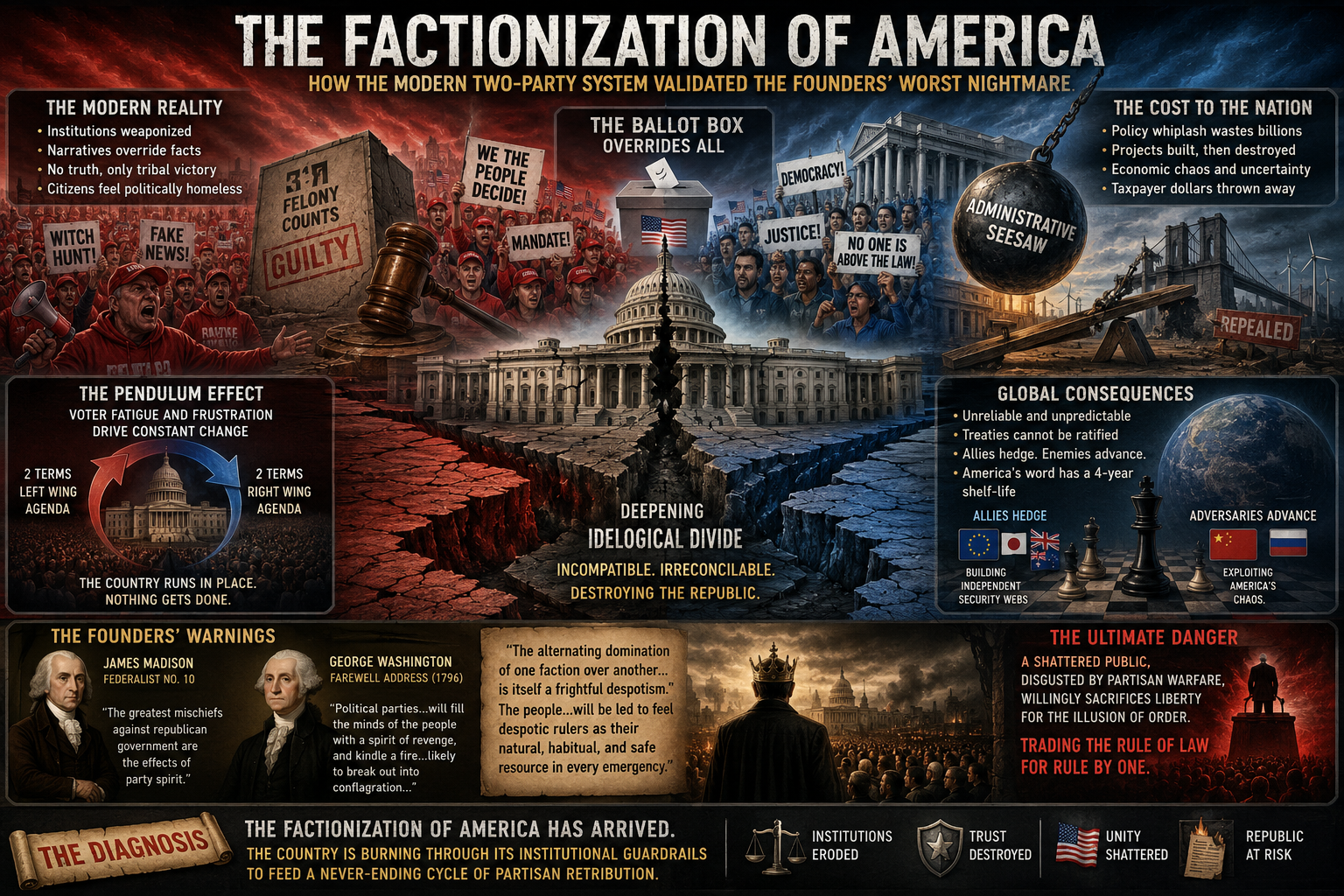
When the New York State Supreme Court sentenced Donald J. Trump to an unconditional discharge, the legal system attempted to navigate one of the most unprecedented moments in American history. Legally, the 34 felony convictions remained part of the permanent judicial record. Politically, however, the American people rendered a separate judgment at the ballot box, returning him to the nation’s highest office despite those convictions. Whether one believes that outcome represented justice, injustice, accountability, or political persecution depends largely upon where they stand politically. What cannot reasonably be disputed is that the moment exposed a much larger constitutional reality – one that reaches far beyond Donald Trump himself.
The significance of that moment was never about a single politician. It was about the growing divide between America’s institutions and the public’s confidence in those institutions. Increasingly, Americans no longer begin with the facts of an investigation, a court ruling, or an agency decision. They begin by asking who controlled the institution that made it. Millions of Republicans question whether Democratic administrations have used prosecutors, intelligence agencies, regulatory bodies, and congressional investigations to pursue political opponents. Millions of Democrats question whether Republican leaders have attempted to undermine elections, expand executive power beyond constitutional limits, politicize oversight, and weaken institutional safeguards for political gain. Each side believes the other has crossed constitutional lines. Each side believes the stakes are existential. Each side increasingly views victory not as an opportunity to govern, but as protection against what it believes the opposing faction will do if it regains power.
That mutual distrust has fundamentally altered the way Americans view government itself. Court decisions are no longer simply legal rulings. Congressional hearings are no longer viewed merely as oversight. Executive orders are no longer temporary policy tools. Federal agencies are no longer broadly assumed to be politically neutral. Nearly every institution has become viewed through a partisan lens, leaving millions of Americans convinced that the machinery of government is being used not only to govern the nation but to defeat political opponents. Whether those perceptions are fully justified in every instance is almost beside the point. Confidence in institutions depends as much upon public trust as legal authority, and that trust has steadily eroded.
The consequences are now visible throughout every level of government. Rather than building upon the work of previous administrations, each change in political power increasingly brings systematic dismantling. Republicans reverse Democratic executive orders. Democrats reverse Republican executive orders. Environmental regulations are written and rewritten. Energy policies expand and contract. Immigration priorities shift dramatically. Major infrastructure initiatives are redesigned or abandoned. International agreements are entered into, withdrawn from, and renegotiated. Billions of taxpayer dollars are spent building policies that survive only until the next election, when billions more are spent undoing them. The result is not steady governance but an expensive political pendulum that repeatedly tears down yesterday’s priorities to build tomorrow’s, only to begin the cycle again four years later.
The offices of President, Governor, Attorney General, District Attorney, and even Congress itself have increasingly become viewed as strategic positions in an ongoing struggle for institutional control. Every election now carries the expectation that investigations will begin, executive powers will expand, appointments will shift ideological balance, regulations will be rewritten, and political opponents will spend the next four years attempting to reverse nearly every major action taken by their predecessors. The Constitution envisioned separated powers acting as checks upon one another. Increasingly, however, Americans witness competing factions attempting to use those same constitutional powers as political weapons against one another. Every new precedent established by one administration becomes justification for the next to answer in kind, creating an escalating cycle of political retaliation that neither side appears willing to end.
That cycle has become self-perpetuating. Each party argues its actions are justified because the other side acted first. Republicans point to Democratic investigations, prosecutions, regulatory actions, and executive authority as evidence of institutional weaponization. Democrats point to Republican challenges to elections, executive actions, congressional investigations, and efforts to reshape federal institutions as proof that extraordinary measures are necessary. The accusations flow in both directions, the responses become increasingly aggressive, and each election simply resets the battlefield for another round. Regardless of which side one supports, the pattern itself has become unmistakable. Political victories are increasingly measured not only by the ability to govern, but by the ability to undo, investigate, prosecute, regulate, subpoena, or otherwise neutralize political opponents. The result is an endless cycle of political retribution that steadily weakens public confidence in every institution caught in the middle.
Taken together, these developments resemble something the United States has rarely acknowledged openly. America is not experiencing a conventional civil war fought with armies across battlefields. It is experiencing what increasingly resembles a political cold civil war – a nation divided into rival factions that occupy the same territory, operate under the same Constitution, and participate in the same elections while steadily losing confidence in one another and in the institutions meant to serve them all. The weapons are no longer muskets and artillery. They are lawsuits, criminal prosecutions, congressional investigations, executive orders, regulatory actions, confirmation battles, media campaigns, and elections increasingly framed as battles for the survival of the Republic itself. Instead of seeking lasting solutions to national problems, each side increasingly prepares for the next opportunity to reclaim power and answer the last round of political blows with new ones of its own.
This is precisely the future the architects of the American Republic feared most. James Madison warned that factions would ultimately place their own interests above those of the nation. George Washington warned that the alternating domination of one faction over another, fueled by revenge and retaliation, would eventually consume the Republic from within. Their concern was never that Americans would disagree. It was that political parties would become so consumed with defeating one another that preserving the constitutional system itself would become secondary. More than two centuries later, that warning deserves renewed attention. If the United States is to move beyond this political cold civil war, the cycle of institutional weaponization and partisan retribution must eventually give way to a renewed commitment to constitutional governance, equal justice, and the principle that no political victory is worth sacrificing the institutions that belong to every American.
👉 Drop your comments below.
© 2026 CompanyXR Media Group. All Rights Reserved.