Tag: NewsXR Editorial

  • Untitled post 278
    The President’s Spouse is an Employee, Not a Volunteer: It Is Time to Formalize the Role
    A NewsXR Editorial
    The United States government is guilty of a decades-long labor violation hidden in plain sight. For generations, the American public has expected the president’s spouse—historically the First Lady—to serve as a full-time diplomat, policy advocate, and cultural ambassador. Yet, the legal compensation for this grueling, high-pressure job remains exactly zero dollars. [1]
    This outdated arrangement is no longer sustainable. It is a fundamental truth, recognized across human history and codified in the biblical statement, that “the laborer is worthy of his hire” (or a worker is due his wages). It is time for Congress to formalize the position, offering an official federal salary and retirement pension to a spouse who chooses to work, while respecting the right of a spouse who chooses to remain entirely private.

    The Exploitation of Forced Labor
    The current system operates on an antiquated, sexist assumption: that a spouse’s labor belongs to the state by virtue of marriage.
    • The Demands: A modern First Spouse manages a robust staff, anchors national policy initiatives, hosts foreign heads of state, and travels the globe on behalf of American interests.
    • The Cost: They are barred by ethics rules from maintaining an independent career while in office, yet they receive no salary. They are expected to look the part of a global leader, but must buy their own designer wardrobes out of pocket.
    This is not “public service”—it is institutionalized exploitation disguised as tradition. As Ronald Reagan famously noted in 1982: “You know, with the first lady the government gets an employee free; they have her just about as busy as they have me.” Barack Obama echoed this decades later, stating: “Michelle would point out first ladies get paid nothing. So there’s clearly not equal pay in the White House when it comes to her and me.”
    The toxic nature of this unwritten mandate becomes clearest when a spouse attempts to opt out. Look no further than the widespread public and media criticism aimed at Melania Trump during the first half of her husband’s initial term. Because she chose to remain in New York for several months so her son could finish the school year, and initially resisted the relentless pacing of public life, she was routinely vilified by critics. This collective outrage exposed a dark truth about the American electorate: the public feels completely entitled to demand full-time, high-stakes representation from an unelected private citizen, getting angry when that forced volunteerism is not instantly and enthusiastically delivered. [1]

    A Legacy of Legislative and Cultural Impact
    Opponents of a formal salary often dismiss the role as purely social, but history soundly refutes this. First Ladies have repeatedly functioned as the architects of major legislative, cultural, and human rights breakthroughs:
    • Civil and Human Rights: Eleanor Roosevelt fundamentally redefined the position as an activist powerhouse, holding all-female press conferences, inspecting New Deal programs, and later drafting the United Nations’ Universal Declaration of Human Rights.
    • National Policy Initiatives: In 1980, Rosalynn Carter successfully lobbied for the landmark Mental Health System Act while formally establishing the Office of the First Lady. In the 1990s, Hillary Clinton spearheaded the creation of the Children’s Health Insurance Program (CHIP), protecting millions of low-income children.
    • Cultural and Historic Preservation: Dolley Madison strategically united political opponents through diplomacy and saved invaluable national treasures during the War of 1812. 150 years later, Jacqueline Kennedy founded the White House Historical Association, transforming the executive mansion into a legally protected, museum-grade living history institution.
    • Health and Education Reform: Betty Ford bravely broke global taboos by publicly detailing her struggles with addiction and breast cancer, forever changing public health stigmas and launching the world-renowned Betty Ford Center. More recently, Michelle Obama altered federal public school nutrition standards through her Let’s Move! campaign, while Dr. Jill Biden made history by maintaining her career as a full-time college professor while simultaneously launching the $1 billion White House Initiative on Women’s Health Research. [1]
    To suggest that this level of legislative, cultural, and systemic output is merely the “volunteer hobby” of a prominent spouse is an insult to the tangible progress they have delivered to the American people.

    A Two-Tiered, Choose-Your-Own-Adventure Solution
    The solution is to treat the role like any other modern professional position, structured around a clear choice:
                      ┌────────────────────────────────────────┐
                      │       Will the Presidential Spouse     │
                      │         Take on Public Duties?         │
                      └───────────────────┬────────────────────┘
                                          │
                       ┌──────────────────┴──────────────────┐
                       ▼                                     ▼
                    [ YES ]                                [ NO ]
       ┌──────────────────────────────┐       ┌──────────────────────────────┐
       │ • Earns standard fed salary  │       │ • Receives $0 taxpayer funds │
       │ • Vests into a federal pension│       │ • Holds zero public duties   │
       │ • Manages a defined budget   │       │ • Pursues private life/career│
       └──────────────────────────────┘       └──────────────────────────────┘
    

    1. The Active Civil Servant
    If a spouse chooses to lean into the public platform, they should be classified as a federal employee. They should earn a transparent salary—perhaps tied to the wage of a Cabinet secretary—and vest into a standard federal retirement pension upon leaving office. Their duties, travel allowances, and staff should be clearly codified by law, removing the ambiguity that leaves them vulnerable to partisan criticism.
    2. The Private Citizen
    If a spouse refuses public life, they should receive nothing from the taxpayer—and the public must expect nothing from them. They should be free to maintain their own private career, completely out of the spotlight. The social, domestic, and ceremonial hosting duties of the White House would simply be handed over to a professional, hired Chief Social Secretary.

    Overcoming the Political Fear
    Critics will immediately cry “nepotism” and balk at the idea of using taxpayer money to pay a president’s family member. But this is a hollow argument. The American taxpayer is already funding the First Spouse’s staff, office space, and travel. Refusing to pay the person doing the actual work is a failure of basic labor ethics, not a defense of fiscal responsibility.
    The era of the “two-for-one” presidency must end. By formalizing the role, Congress can finally align American governance with modern values—ensuring that if a world leader’s spouse works for the country, they are treated with the professional dignity, pay, and retirement security they have rightfully earned.

    Copyright 2026 – CompanyXR Mediia Group

  • Sunday Dinner & That’s What’s Up Broome County: The Quiet Heroes Keeping Our Seniors Connected

    Sunday Dinner & That’s What’s Up Broome County: The Quiet Heroes Keeping Our Seniors Connected

    Sunday Dinner & That’s What’s Up Broome County: The Quiet Heroes Keeping Our Seniors Connected
    BINGHAMTON, NY — When you think of a traditional Sunday dinner, you think of more than just a hot meal. You think of safety, family, and the comforting reassurance that someone is looking out for you. Across Broome County, a dedicated group of local residents is actively expanding that exact familial spirit past their own dining tables and directly into the homes of our most vulnerable neighbors.
    They are the driving force behind Faith in Action Volunteers (FIAV), a homegrown care network managed by the Broome County Council of Churches. Operating entirely on neighborly kindness, this initiative pairs local volunteers with homebound frail elderly, chronically ill, and disabled residents. Their shared mission is simple yet vital: helping our seniors maintain their absolute independence, health, and dignity right at home. [1, 2]
    That’s What’s Up: Breaking Isolation One Grocery Run at a Time
    While regional headlines frequently focus on sweeping political or economic changes, the real backbone of the Southern Tier is reinforced through much quieter acts of service. Every single week, local volunteers step up to provide critical, non-medical home services.
    The day-to-day impact of these efforts acts as a literal lifeline across our towns:
    • The Shopper Program: Volunteers receive grocery lists and payment, head out to local markets, and drop fresh, nutritious food directly to seniors who cannot leave their homes.
    • Ramp It Up: Teams regularly volunteer to construct sturdy wheelchair ramps, transforming previously inaccessible houses into open homes. [1]
    • Chop and Chat: Local senior centers host these group sessions, bringing older adults together to prep healthy ingredients, share recipes, and combat social isolation. [1, 2]
    • Essential Transit: Beyond food, volunteers donate their time and vehicles to drive neighbors to critical medical appointments, provide light housekeeping, and make weekly companionship phone calls.
    Why This is the Ultimate “Sunday Dinner” Story
    This isn’t corporate charity—it is pure community fiber. It is an Endicott neighbor giving up a Tuesday morning to drive a stranger to dialysis. It is a Binghamton resident picking up an extra gallon of milk for someone three blocks away.
    These volunteers provide the ultimate gift: peace of mind. They prove that in Broome County, we do not let our elders slide into invisibility. We pull up an extra chair, we check in, and we look out for one another.
    How to Get Involved or Request Help
    The need for local helping hands remains exceptionally high, particularly for the expanding Shopper Program. If you have a valid driver’s license and a few spare hours a month, you can directly change a senior’s life.
    • To Volunteer: Reach out directly to the organizers listed on the official Broome County Council of Churches Volunteer Portal. You can also coordinate with the coordinators by calling the FIA office at (607) 724-9130 ext. 318.
    • To Refer a Senior: If you know an older adult resident in Binghamton, Johnson City, Endicott, or the surrounding towns who needs assistance with groceries or medical transit, use the same contact line to request a volunteer pairing.
    And that’s what’s up Broome County!

  • A NewsXR Editorial: Starbucks Is Wrong.

    A NewsXR Editorial: Starbucks Is Wrong.

    A NewsXR Editorial

    Starbucks Fired Two Employees for Defending Themselves. We Believe the Company Is Wrong.

    When two masked men entered a Starbucks on South Grand Boulevard in St. Louis in December 2023, employees Michael Harris and Devin Jones-Ransom were forced into a situation no worker should ever have to face. The suspects demanded cash and displayed what appeared to be a handgun. Harris attempted to comply, but because he lacked the manager authorization needed to immediately open the register, one of the robbers pistol-whipped him in the head.

    Believing their lives were in immediate danger, Harris and Jones-Ransom fought back. They subdued one suspect and held him until police arrived, while the second suspect fled and was later apprehended. During the struggle, part of the weapon broke away, revealing it to be a replica firearm. Both suspects were eventually convicted and sentenced to prison.

    A few weeks later, Starbucks fired both employees for violating the company’s workplace safety policy, which directs workers to comply with robbery demands and avoid physical intervention. Harris and Jones-Ransom later filed a wrongful termination and negligence lawsuit against Starbucks. In March 2026, the Missouri Court of Appeals rejected the company’s attempt to force the case into private arbitration, allowing the lawsuit to proceed in St. Louis Circuit Court.

    The courts will decide whether Starbucks acted within the law, but the question of whether the company acted fairly is much easier to answer.

    We understand why Starbucks maintains a policy of inaction, submission, and de-escalation during a robbery. In many situations, compliance is the safest response, and employers have every right to train workers not to resist, pursue suspects, or place themselves and others at greater risk over company property. Those policies exist for a legitimate reason, and we do not dispute the value of having them.

    What we dispute is the rigid and deeply unfair application of that policy after an employee has already been violently attacked and reasonably believes his life is in danger. Harris reportedly tried to comply. He did not rush the suspects, chase them from the store, or decide that protecting a cash register was worth risking his life. He was unable to open the register quickly enough, and he was struck in the head with what appeared to be a firearm.

    At that point, this was no longer a simple robbery in which an employee was being asked to hand over money. It had become a violent assault, and the people inside that store had no way of knowing that the weapon was fake or what the suspects intended to do next. Too many people have heard stories of robberies where the money was surrendered and the victims were still beaten, shot, or killed. Compliance does not come with a guarantee of survival.

    No one sitting in a corporate office can fairly recreate the fear, confusion, pain, and adrenaline of that moment. Starbucks executives were not inside the store, they were not staring at what appeared to be a gun, and they were not the ones forced to decide within seconds whether fighting back was the only way to stay alive. The employees were the people facing that danger, and their actions must be judged with a real understanding of the circumstances they were placed in.

    Starbucks still had the right to address the policy violation, but termination was not the only option available. The company could have issued a formal reprimand, required additional training, imposed a suspension, or taken another corrective action that reinforced its safety rules while acknowledging the extraordinary danger these employees faced. Discipline could have been measured, humane, and grounded in the reality of the event.

    Instead, Starbucks chose to fire them, and that decision appears arbitrary, capricious, and fundamentally wrong. It sends the message that corporate policy must be followed without exception, even when an employee has already been assaulted and reasonably believes he may be seriously injured or killed. Policies are supposed to protect people, not become weapons used against them after they survive a violent encounter.

    People should not lose their jobs for protecting themselves when they reasonably believe their lives are in immediate danger. It is easy to second-guess a survival decision after the fact, but it is entirely different to make that decision while injured, terrified, and unsure whether the next moment may be your last.

    Because of the blatant unfairness of Starbucks punishing these employees for defending themselves, I will never spend another penny with the brand, and that’s a fact.

    👉 What do you think? Was Starbucks right to enforce its policy, or should the company have recognized the extraordinary circumstances these employees faced? Drop your comments below.

    The civil allegations remain pending. Starbucks denies liability, and no final ruling has been issued on the underlying claims.

    © 2026 CompanyXR Media Group – NewsXR. All Rights Reserved.

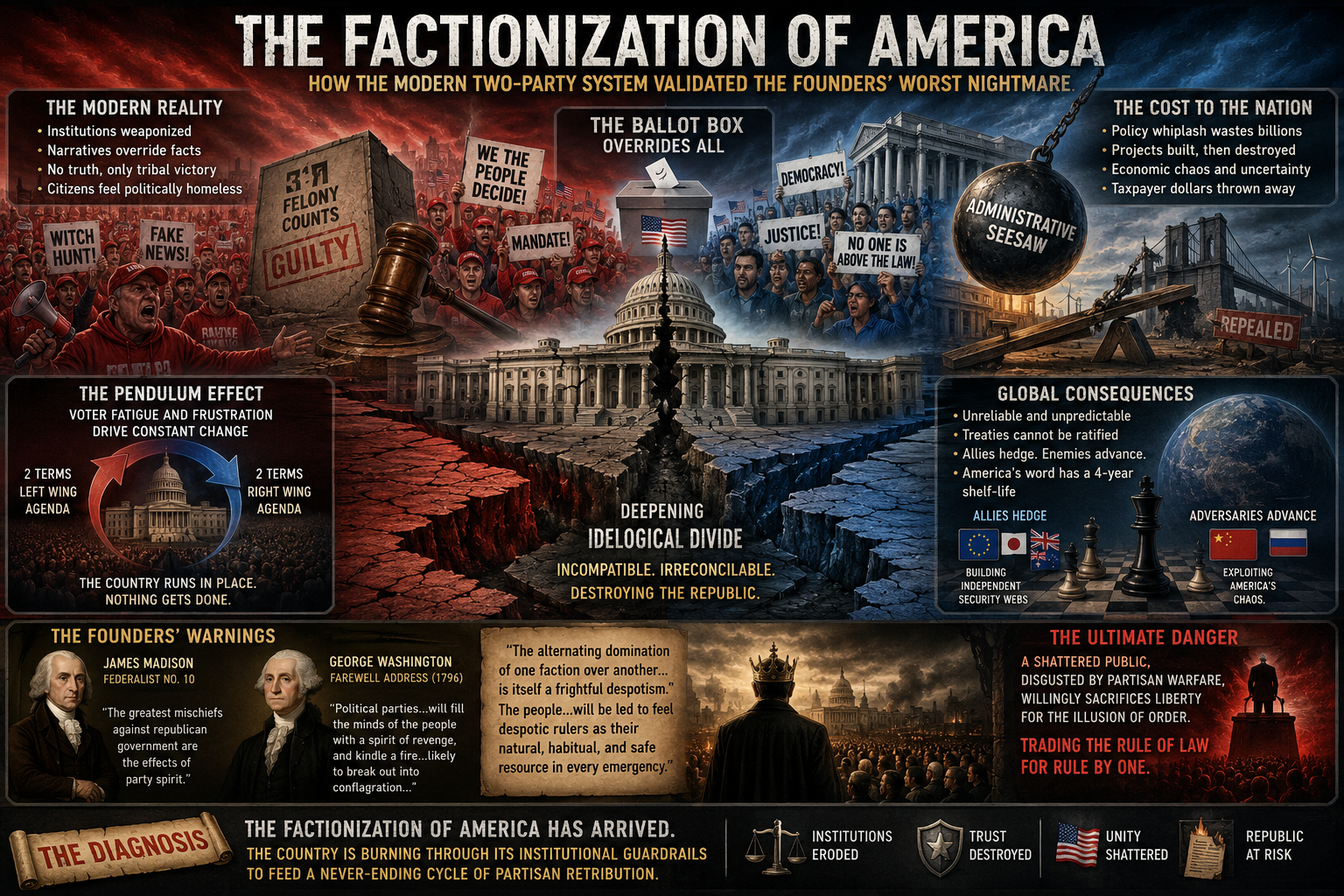
  • The Factionization of America: How the Modern Two-Party System Validated the Founders’ Worst Nightmare

    The Factionization of America: How the Modern Two-Party System Validated the Founders’ Worst Nightmare

    The Factionization of America: How the Modern Two-Party System Validated the Founders’ Worst Nightmare

    By the NewsXR Editorial Board

    When the New York State Supreme Court sentenced Donald J. Trump to an unconditional discharge, the legal system attempted to navigate one of the most unprecedented moments in American history. Legally, the 34 felony convictions remained part of the permanent judicial record. Politically, however, the American people rendered a separate judgment at the ballot box, returning him to the nation’s highest office despite those convictions. Whether one believes that outcome represented justice, injustice, accountability, or political persecution depends largely upon where they stand politically. What cannot reasonably be disputed is that the moment exposed a much larger constitutional reality – one that reaches far beyond Donald Trump himself.

    The significance of that moment was never about a single politician. It was about the growing divide between America’s institutions and the public’s confidence in those institutions. Increasingly, Americans no longer begin with the facts of an investigation, a court ruling, or an agency decision. They begin by asking who controlled the institution that made it. Millions of Republicans question whether Democratic administrations have used prosecutors, intelligence agencies, regulatory bodies, and congressional investigations to pursue political opponents. Millions of Democrats question whether Republican leaders have attempted to undermine elections, expand executive power beyond constitutional limits, politicize oversight, and weaken institutional safeguards for political gain. Each side believes the other has crossed constitutional lines. Each side believes the stakes are existential. Each side increasingly views victory not as an opportunity to govern, but as protection against what it believes the opposing faction will do if it regains power.

    That mutual distrust has fundamentally altered the way Americans view government itself. Court decisions are no longer simply legal rulings. Congressional hearings are no longer viewed merely as oversight. Executive orders are no longer temporary policy tools. Federal agencies are no longer broadly assumed to be politically neutral. Nearly every institution has become viewed through a partisan lens, leaving millions of Americans convinced that the machinery of government is being used not only to govern the nation but to defeat political opponents. Whether those perceptions are fully justified in every instance is almost beside the point. Confidence in institutions depends as much upon public trust as legal authority, and that trust has steadily eroded.

    The consequences are now visible throughout every level of government. Rather than building upon the work of previous administrations, each change in political power increasingly brings systematic dismantling. Republicans reverse Democratic executive orders. Democrats reverse Republican executive orders. Environmental regulations are written and rewritten. Energy policies expand and contract. Immigration priorities shift dramatically. Major infrastructure initiatives are redesigned or abandoned. International agreements are entered into, withdrawn from, and renegotiated. Billions of taxpayer dollars are spent building policies that survive only until the next election, when billions more are spent undoing them. The result is not steady governance but an expensive political pendulum that repeatedly tears down yesterday’s priorities to build tomorrow’s, only to begin the cycle again four years later.

    The offices of President, Governor, Attorney General, District Attorney, and even Congress itself have increasingly become viewed as strategic positions in an ongoing struggle for institutional control. Every election now carries the expectation that investigations will begin, executive powers will expand, appointments will shift ideological balance, regulations will be rewritten, and political opponents will spend the next four years attempting to reverse nearly every major action taken by their predecessors. The Constitution envisioned separated powers acting as checks upon one another. Increasingly, however, Americans witness competing factions attempting to use those same constitutional powers as political weapons against one another. Every new precedent established by one administration becomes justification for the next to answer in kind, creating an escalating cycle of political retaliation that neither side appears willing to end.

    That cycle has become self-perpetuating. Each party argues its actions are justified because the other side acted first. Republicans point to Democratic investigations, prosecutions, regulatory actions, and executive authority as evidence of institutional weaponization. Democrats point to Republican challenges to elections, executive actions, congressional investigations, and efforts to reshape federal institutions as proof that extraordinary measures are necessary. The accusations flow in both directions, the responses become increasingly aggressive, and each election simply resets the battlefield for another round. Regardless of which side one supports, the pattern itself has become unmistakable. Political victories are increasingly measured not only by the ability to govern, but by the ability to undo, investigate, prosecute, regulate, subpoena, or otherwise neutralize political opponents. The result is an endless cycle of political retribution that steadily weakens public confidence in every institution caught in the middle.

    Taken together, these developments resemble something the United States has rarely acknowledged openly. America is not experiencing a conventional civil war fought with armies across battlefields. It is experiencing what increasingly resembles a political cold civil war – a nation divided into rival factions that occupy the same territory, operate under the same Constitution, and participate in the same elections while steadily losing confidence in one another and in the institutions meant to serve them all. The weapons are no longer muskets and artillery. They are lawsuits, criminal prosecutions, congressional investigations, executive orders, regulatory actions, confirmation battles, media campaigns, and elections increasingly framed as battles for the survival of the Republic itself. Instead of seeking lasting solutions to national problems, each side increasingly prepares for the next opportunity to reclaim power and answer the last round of political blows with new ones of its own.

    This is precisely the future the architects of the American Republic feared most. James Madison warned that factions would ultimately place their own interests above those of the nation. George Washington warned that the alternating domination of one faction over another, fueled by revenge and retaliation, would eventually consume the Republic from within. Their concern was never that Americans would disagree. It was that political parties would become so consumed with defeating one another that preserving the constitutional system itself would become secondary. More than two centuries later, that warning deserves renewed attention. If the United States is to move beyond this political cold civil war, the cycle of institutional weaponization and partisan retribution must eventually give way to a renewed commitment to constitutional governance, equal justice, and the principle that no political victory is worth sacrificing the institutions that belong to every American.

    👉 Drop your comments below.

    © 2026 CompanyXR Media Group. All Rights Reserved.