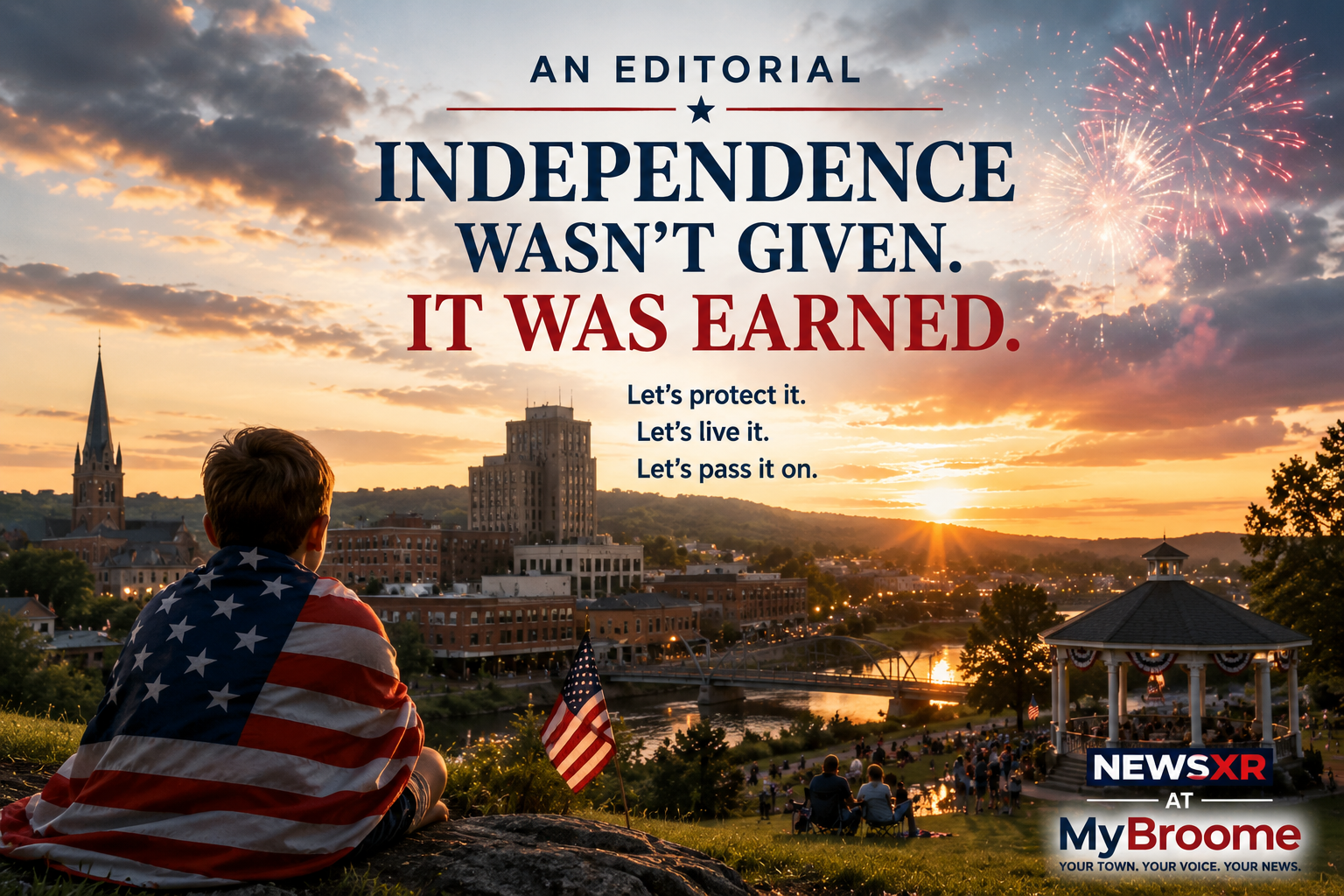
**Independence Day Feature Editorial**
**The Fourth of July, the American Dream, and the People Still Waiting for a Square Deal**
By RD Milano
For NewsXR / Broome County Newswire
Every Fourth of July, America tells its story again. Flags rise, families gather, fireworks light up the night, and communities come together to celebrate the birth of the United States of America.
For a younger generation growing up in a country full of noise, division, pressure, doubt, and constant information, it is worth pausing to remember what the Fourth of July actually means. The Fourth is not just a holiday, and it is not just fireworks, cookouts, parades, and red, white, and blue. It marks the day in 1776 when the Second Continental Congress adopted the Declaration of Independence, announcing that the American colonies no longer accepted rule by the British Crown.
By 1776, the colonies had lived for well over a century under the authority of the British Crown. That long history is an important fact because the Revolution was not a sudden argument over one tax or one law. It was the breaking point after generations of colonial life under a distant government that claimed authority over people who had no direct representation in the body making decisions for them.
The colonists were not simply annoyed with a king. They were rejecting a system of power that made decisions over their lives without giving them a real voice in those decisions. The British government taxed the colonies without allowing them direct representation in Parliament. It imposed laws from across the ocean on people who had no meaningful vote in the body passing those laws. It restricted trade, interfered with local self-government, and used royal governors and imperial authority to override colonial assemblies.
For the colonists, that was not just bad policy. It was rule without consent.
The Declaration of Independence accused the king of obstructing justice, controlling judges, keeping standing armies among the people, cutting off trade, imposing taxes without consent, denying trial by jury in some cases, and using government power to make the colonies dependent, submissive, and unheard. In plain language, the complaint was this: power had become distant, unaccountable, and too comfortable ignoring the people living under it.
The colonists believed they were being treated less like citizens with rights and more like subjects expected to obey. That distinction sits at the heart of the American Revolution. A subject is ruled, but a citizen has a voice. A subject waits for permission, but a citizen can challenge power and take part in the authority government must answer to.
That is why the Declaration of Independence was so powerful. It was not only a breakup letter to a king. It was a statement that government must answer to the people, not the other way around.
At the heart of the Declaration is the belief that human beings have rights that government does not create and should not be allowed to destroy: life, liberty, and the pursuit of happiness. Those words became part of the American identity, even though America was not living fully by them when they were written. The nation was born with deep contradictions, including slavery, exclusion, poverty, and unequal rights. Many people were left outside the promise from the beginning.
But the power of the Declaration is that it gave future generations a standard to hold America to. It gave people words to demand better, and it gave the country a mirror. Every generation since has had to ask whether America is living up to what it claimed to believe.
The Fourth of July is a celebration, but it is also a challenge. It reminds us that freedom is not only something declared once in history. Freedom has to be protected, expanded, defended, and made real in the lives of actual people.
That is where the American Dream comes in.
The American Dream is the belief that people should have a fair chance to build a life. Work should mean something. Families should be able to rise, children should have a chance to do better than their parents, and a person should be able to struggle, recover, rebuild, and still belong.
At its best, the American Dream says your future should not be permanently trapped by your birth, your poverty, your past, your mistakes, your family name, your neighborhood, or the worst thing that ever happened to you. It says there should be room to begin again.
That dream has inspired generations. People crossed oceans for it. Workers fought for it. Soldiers defended it. Families sacrificed for it. Civil rights leaders demanded that it apply to everyone. Communities across the country still measure their hopes against it.
But for too many Americans, the dream is no longer something they feel they are moving toward. It is something they hear politicians talk about while they are working two jobs, sometimes three, and still falling behind.
A generation of Americans has never truly had a square deal. They were told to work hard, but wages have not kept pace with the cost of living. They were told education would open doors, but many were handed debt before they were handed opportunity. They were told homeownership was part of the American Dream, but rent alone now drains entire paychecks for working families. They were told the system rewards effort, but too many people are one medical bill, one car repair, one lost shift, or one rent increase away from crisis.
Many Americans live paycheck to paycheck, if they are lucky enough to have a steady paycheck at all. They work in hospitals, restaurants, warehouses, schools, retail stores, factories, nursing homes, delivery routes, construction sites, and service jobs that keep this country running. They are not lazy. They are not looking for a handout. They are exhausted from trying to survive inside an economy that keeps asking more from them while giving less back.
And still, Americans remain among the most generous people in the world. That says something powerful about who we are. Even under pressure, people still give. They donate to families after fires. They bring food to neighbors. They raise money for strangers. They volunteer, serve, pray, share, rescue, rebuild, and show up when someone else is hurting.
That generosity is not weakness. It is one of the strongest parts of the American character.
But generosity from ordinary people cannot become an excuse for failure by those in power. A community should not have to keep passing the hat because government, industry, and political leadership refuse to build systems that treat working people with dignity.
For families living paycheck to paycheck, independence can feel fragile. For people facing addiction, trauma, illness, disability, or reentry after incarceration, freedom can feel like a door that technically opens but leads into another wall. For seniors choosing between food, rent, and medicine, independence can feel like a word spoken by people who do not understand the pressure.
And for people without stable housing, freedom can feel almost theoretical. You can be free on paper and still have nowhere safe to sleep. You can live in the United States of America and still be moved from a sidewalk to a shelter, from a shelter to a motel, from a motel to uncertainty, and from uncertainty to public blame. You can be told you have rights while also being treated like your presence is a problem to be managed, hidden, removed, or cleared before it makes the rest of us uncomfortable.
That is not the full promise of America. It is the gap between what we celebrate and what we still have to build.
Here in Broome County, that gap has become impossible to ignore. The Knights Inn fire in Endwell took six lives, including three young children. The motel had been used as emergency housing for vulnerable residents. The criminal case will move through the courts, and the accused is entitled to the presumption of innocence unless proven guilty.
But the public questions are larger than one criminal case. How did families end up there? What conditions existed? What oversight was in place? What did public agencies and property owners know? What inspections occurred, what warnings were missed, and what systems failed before the fire ever started?
Those questions are not political noise. They are the questions a community has a right to ask after six people die.
In the days after the fire, a protest encampment formed outside the Broome County Office Building at 60 Hawley Street. For some, the tents were a disruption. For others, they were a symbol of grief, anger, and the desperate need for housing reform. For the unhoused, they were hope.
Then the encampment was cleared. City officials cited permit rules. The physical tents were removed. The protest was pushed out of the space it had occupied.
But the issue did not leave with the tents.
The Fourth of July asks us to remember that government is not above the people. Government exists because of the people. Public officials are not meant to be shielded from discomfort when the public is grieving. They are meant to answer it.
A code book may explain a city’s authority. It does not explain its conscience.
When people are grieving, displaced, afraid, and demanding answers from government, the first response should not be to search for a technical basis to remove the visible discomfort. The first response should be to listen, answer, meet with organizers, acknowledge what failed, and explain what permanent changes are being made. That is not weakness. It is accountable government.
The American story began with protest against power that would not listen. That does not mean every protest is perfect, every public space can be unmanaged forever, or government has no responsibility to keep order. It does mean government should be careful when it treats public grief and public pressure as a code-enforcement problem, especially in the shadow of tragedy, when the people protesting are asking whether the most vulnerable among us were placed in danger.
The American promise we celebrate on the Fourth is supposed to include the right of the people to speak, gather, object, and demand better from those in power.
Today, too many Americans once again feel ruled by powers and principalities that refuse to hear them. Political parties have become so obsessed with destroying each other that they have forgotten how to govern. Too many leaders on the left and the right have forgotten their duty to the American people. They have forgotten their purpose.
Government was not created to serve itself. Political office was not created for endless war between parties. Public power was not created so leaders could chase attention, protect donors, punish enemies, and leave ordinary people begging for stability.
The Declaration of Independence teaches that government gets its just power from the consent of the governed. That means the people are not supposed to be background noise. They are not supposed to be managed, ignored, divided, or used every election season and then forgotten when the governing begins.
The American Dream does not survive by fireworks alone. It survives when communities refuse to accept that poverty is normal, homelessness is inevitable, addiction is disposable, or unsafe emergency housing is good enough for people with nowhere else to go. It survives when children placed in emergency housing are given the same safety we would demand for our own children, and when vulnerable people are no longer treated as paperwork, statistics, cases, placements, problems, or political liabilities.
Every person without a home is still a person with a name, a story, a past, a future, and a God-given dignity that government did not create and has no right to erase. Every working family falling behind is still part of the American promise. Every person who has done everything they were told to do and still cannot get ahead deserves more than lectures about responsibility from leaders who refuse to accept their own.
This Fourth of July, we honor the country, the flag, and the sacrifices that made liberty possible. But honoring America does not require pretending America is finished.
Love of country is not silence. It is not looking away. It is believing the promise is real enough to demand that it reach more people.
That is what younger Americans need to understand about the Fourth. It is not just about what happened in 1776. It is about what every generation does with the promise that was declared.
Do we make it smaller, or do we make it real? Do we use freedom only as a slogan, or do we build communities where people can actually live with dignity? Do we celebrate liberty while ignoring people who are trapped in poverty, homelessness, unsafe housing, addiction, hunger, fear, or public neglect?
Or do we tell the truth, even when the truth interrupts the celebration?
Here in Broome County, the work in front of us is clear. We need safe emergency housing, real oversight of properties used for public assistance placements, transparent answers about the Knights Inn fire, and housing programs that move people toward stability instead of temporary survival.
We need leaders willing to face public discomfort instead of removing it from view. We also need a state and a nation willing to admit that the American Dream cannot survive if millions of working people spend their lives running faster just to fall further behind.
This year, NewsXR and MyBroome.com pray that leaders on the left and the right remember the sacred document at the center of this holiday. We pray they remember that government exists to serve the people, not itself. We pray they remember that the American experiment depends on more than speeches, campaigns, party victories, and patriotic slogans. It depends on whether the people still have a government that hears them.
The Fourth of July is about independence, but independence is not only a national declaration. It is also a local responsibility.
That responsibility means building a community where the American Dream does not belong only to the comfortable, the housed, the connected, or the already stable. It must also reach people who are working, struggling, recovering, displaced, aging, starting over, or still standing outside government buildings asking whether anyone inside is listening.
After the fireworks fade and the long weekend ends, the question will remain: what does freedom mean if so many people are still waiting for a square deal?
——————————————————-


© 2026 CompanyXR Media Group – All Rights Reserved
See less
newswire.mybroome.com
www.newswire.mybroome.com